
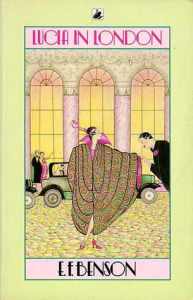
 I admit I was a latecomer to E. F. Benson’s Mapp and Lucia novels, and that the main reason I picked them up was I was curious about Benson’s hometown of Rye (and its portrayal as “Tilling” in the series) and that on my first go at Queen Lucia I wasn’t entirely enraptured. I found Lucia grating and the rest of the characters tiresome (or “tarsome,” as Lucia’s once-loyal deputy Georgie Pillson would say). Then I realized that was exactly what Benson was going for. Once I recognized Queen Lucia for what it was – a lampooning of social snobbery in all its forms – I picked it up for a second time and enjoyed it immensely, then went straight on to Miss Mapp and enjoyed that even more. And then I took a long break – too long of a break – from Lucia’s Riseholme and Mapp’s Tilling, always meaning to return. Return I finally did, stuck in the house waiting for the COVID-19 situation to stabilize and in desperate need of something fun and lighthearted. Lucia delivered, as I knew that she would.
Lucia in London is the third in the Mapp and Lucia series, and the action is really beginning to pick up. When the novel opens, Riseholme is all atwitter at the news that Peppino – that’s Lucia’s indulgent husband, Philip Lucas – has been left a handsome inheritance by his Aunt Amy. Georgie Pillson and Daisy Quantock gather for a good gossip and speculation session and wonder how much Peppino has actually inherited. There’s cash, a house in London, and the rumor of a string of fabulous pearls. After they turn over all the possibilities, Georgie is dispatched to get the facts out of Lucia, who is putting on an excellent show of being bereaved.
‘Tell me,’ he said, ‘how much do you think it will all come to? The money he’ll come into, I mean.’
Lucia also threw discretion to the winds, and forgot all about the fact that they were to be so terribly poor for a long time.
‘About three thousand a year, Peppino imagines, when everything is paid. Our income will be doubled, in fact.’
Georgie gave a sigh of pure satisfaction. So much was revealed, not only of the future, but of he past, for no one hitherto had known what their income was. And how clever of Robert Quantock to have made so accurate a guess!
‘It’s too wonderful for you,’ he said. ‘And I know you’ll spend it beautifully. I had been thinking over it this afternoon, but I never thought it would be as much as that. And then there are the pearls. I do congratulate you.’
Lucia suddenly felt that she had shown too much of the silver (or was it gold?) lining to the cloud of affliction that had overshadowed her.
‘Poor Auntie!’ she said. ‘We don’t forget her through it all. We hoped she might have been spared to us a little longer.’
Eventually Lucia gives up her show of being grief-stricken (it’s an elderly aunt-in-law whom they almost never saw, after all) and divulges that they are going to keep the Brompton Square house in London – for Peppino, of course! His memories, you know, of dear Auntie. And then there’s the Royal Astronomers’ Society, just the thing for darling Peppino. Of course it will be a sacrifice for Lucia, who cannot imagine life away from her beloved Riseholme, with its Elizabethan flair and Georgie just nipping across the green to play duets on her piano – dear Beethoven and Mozartino. But to London Lucia will go.
And to London Lucia does go. And dives straight into the life of the capital, to Riseholme’s astonishment. She immediately starts appearing in the social columns – someone named “Hermione” has a beat on Lucia’s every movement – and never seems to miss an opportunity to dine with some luminary or another, even if Riseholme’s most famous part-time resident, the prima donna Olga Bracely, manages to dodge Lucia despite being her Brompton Square neighbor. It’s not long before Lucia is the toast of London (so exhausting, darling, but think of dear Peppino) and brings a party of her smart new friends down to Riseholme for a weekend, where they proceed to snub the entire town, mock the new History Museum, and generally make asses of themselves. Naturally E. F. Benson cannot let Lucia get away with this sort of behavior, so you can expect the weekend will devolve, hilariously, into disaster. I won’t tell you how, exactly. But suffice it to say: Lucia takes her medicine.
Already she had learned a lesson about that, for if she had only told Georgie that she had been coming down for a weekend, and had bidden him to lunch and dinner and anything else he liked, he would certainly have got Olga to pop in at The Hurst, or have said that he couldn’t dine with Olga on that fateful Sunday night because he was dining with her, and then no doubt Olga would have asked them all to come in afterwards. It had been a mistake to kick Riseholme down, a woeful mistake, and she would never do such a thing again. It was a mistake also to be sarcastic about anybody till you were sure they could not help you, and who could be sure of that?
Chastened, Lucia returns to London and to her glittering social circle there. She has annexed some of the social grande dames, who (along with Hermione, whose identity is revealed during the disastrous Riseholme weekend) call themselves the Luciaphils, because they enjoy her so much. But she’s not a complete success – her efforts to annex “dear Marcia,” the Duchess of Whitby, prove more challenging than anticipated. Eventually even “dear Marcia” comes ’round, with the help of Adele, Lady Brixton, the chief Luciaphil.
‘Tell me some more about her,’ she said.
Adele clapped her hands.
‘Ah, that’s splendid,’ she said. ‘You’re beginning to feel kinder. What would we do without our Lucia I can’t imagine. I don’t know what there would be to talk about.’
‘She’s ridiculous!’ said Marcia, relapsing a little.
‘No, you mustn’t feel that,’ said Adele. ‘You mustn’t laugh at her ever. You must just richly enjoy her.’
‘She’s a snob!’ said Marcia, as if this was a tremendous discovery.
‘So am I: so are you: so are we all,’ said Adele. ‘We all run after distinguished people like–like Alf and Marcelle. The difference between you and Lucia is entirely in her favour, for you pretend you’re not a snob, and she is perfectly frank and open about it. Besides, what is a duchess like you for except to give pleasure to snobs? That’s your work in the world, darling; that’s why you were sent here. Don’t shirk it, or when you’re old yo will suffer agonies of remorse. And you’re a snob too. You like having seven–or was it seventy?–Royals at your dance.’
‘Well, tell me some more about Lucia,’ said Marcia, rather struck by this ingenious presentation of the case.
In another day and age, Adele would have been a lawyer. That’s quite an argument (if rather patronizing) on Lucia’s behalf, and I’m sure I would have been powerless against it – were I not already a dedicated Luciaphil.
‘And then there are lots who will revel in Lucia, and I the foremost. I’m devoted to her; I am really, Marcia. She’s got character, she’s got an iron will, and I like strong talkative women so much better than strong silent men.’
‘Yes, she’s got will,’ said Marcia. ‘She determined to come to my ball, and she came. I allow I gave her the chance.’
‘Those are the chances that come to gifted people,’ said Adele. ‘They don’t come to ordinary people.’
I revel in Lucia, too. Yes, she is a snob, and she can be ridiculous at times – often, in fact. That’s by design. Lucia talks annoying baby talk and she thinks she has a right to control the lives of everyone around her, from darling Peppino to the grumbling Riseholmites. But she is a “strong talkative woman” and much better to cheer her on than to grind her down. You can’t help but love Lucia and you can’t help but root for her, whether she’s taking London by storm or wrenching control of Riseholme’s committees back from her frenemy Daisy Quantock. Lucia suffers some humiliating defeats, to be sure, but she learns from her mistakes (which is more than many can say, isn’t it?) and she’s never down for long. She is, in fact, an icon.
All hail the Queen.
 covered in flour