
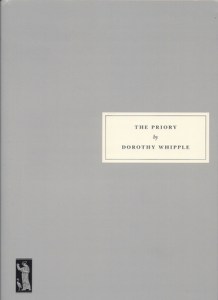
 Dorothy Whipple is completely underrated! One of the coterie of “middlebrow” writers of the Interwar period, her books have been famously slighted by Virago (which has a rule that it will not reprint anything “below the Whipple line”) – but fortunately for readers, Persephone recognizes Whipple’s merits and has reprinted all of her novels, most (or all?) of her short stories and, soon, her memoirs. Whipple is a mainstay of Persephone’s stable of (reprinted) authors, and I’m glad of it, because it means her books are in print and accessible, even if my library doesn’t stock them.
I read my first Whipple, Greenbanks, a few years ago, and it’s taken me far too long to get back to Whipple’s vivid world. I have two dove grey Persephone Whipples on my shelf, though, and they’ve been calling to me. And I knew exactly where I wanted to start – with The Priory, which sounded (and was) right up my street. The Priory is the story of an eccentric gentry family living in Saunby Priory, a fictional great house in the English Midlands. When the novel opens, the house is populated by the widowed Major Marwood, long retired from His Majesty’s Army and caring only for his annual cricket tournament; Victoria Marwood, the Major’s artist sister; and Christine and Penelope Marwood, the Major’s two nearly-grown daughters. Christine and Penelope are still living in their childhood nursery – it hasn’t occurred to anyone that they should move downstairs – and have created a world unto themselves. Saunby itself is a world of its own, but it’s all upended when the Major decides to remarry, ideally someone suitable and sensible, who can help him manage Saunby’s expenses (except during cricket, of course). The Major settles on Anthea Sumpton, the 37-year-old spinster daughter of a neighbor, who appears to like cricket. Anthea is at first overwhelmed by Saunby, with its unmanageable servants and junk-filled rooms, and then events begin to move fast and furious. The first thing that happens is: Christine falls in love, gets engaged, and has to face the idea of leaving Saunby.
She unloosed Rough and went her round. She went to stand in her favourite places. Under the chestnut tree, bare now and like a many-branched candlestick without candles. Under this tree she and Penelope had always found the best chestnuts. They peeled off the spiked cases, so fierce without and lined so soft within, and picked out with delighted fingers the smooth, highly polished nuts. They took them back to the nursery, saying to each other that you could make the most beautiful doll’s furniture out of chestnuts if only you knew how.
She went into Lake Wood. She stood in the avenue and looked across to the grey gables and chimney-stacks of the house, with the towering West Front alongside, pierced with blue sky in place of windows. Lovely, lovely Saunby, she thought. Wherever I go, there’ll never be anywhere so lovely.
Penelope, meanwhile, is furious with her sister for changing everything and upending their cozy nursery lives.
“Everybody’s having babies,” she said. Everybody.”
“Women do have babies,” remarked Victoria. “Even in these days. You’ll find as you go through life that your friends are all doing the same thing at the same time.”
She buttered more toast.
“First they’re all going away to school, then they’re all being presented, then they’re all getting engaged and married. Then they’re all having babies, then they’re all attending their children’s weddings and by and by you’ll find they’re all actually being buried. If you’re not doing the same things yourself, you notice it more. You’d better hurry to join the series, Penelope, or you’ll feel out of it.”
“Did you feel out of it, Aunt Victoria?”
“No, my dear, but I don’t think I ever wanted to be in it, particularly,” said Victoria, helping herself liberally to marmalade.
“Perhaps I shall be like you,” said Penelope.

Eventually, Penelope comes up with a life plan of her own, marrying for companionship and to escape Saunby, which is becoming a bit too hot for an adult daughter of the house, thanks to Anthea (who the reader can’t help but sympathize with – the Major is far from an ideal husband). The second half of the novel focuses on Christine’s marriage and how it impacts the sisters’ relationship. Christine finds marriage more challenging than she expected, and she pines for Saunby – to her, a true spiritual home. Meanwhile, as the shadow of war grows longer over England – the action takes place in 1939 – Christine finds herself despondent, jaded, and worried about the future and what it will bring to her children.
‘People say: “Oh, it’s not like that for girls now.” But it is, and it’s going to be more like it than ever, it seems to me. According to these papers it is. Women are being pushed back into homes and told to have more babies. They’re being told to make themselves helpless. Men are arming like mad, but women are expected to disarm, and make themselves more vulnerable than they already are by nature. No woman is going to choose a time like this to have a baby in. You can’t run very fast for a bomb-proof shelter if you have a baby inside you, and a bomb-proof shelter is not the place you would choose to deliver it in. No protection against gas is provided for children under three, this paper says, so presumably the baby you have laboured to bring into the world must die if there is a gas attack. Look at this,’ Christine directed herself. ‘In this paper, the headlines are about the necessity of preparation for war and the leader is about the necessity for an increase in the population. “The only hope,” they say. They urge women to produce babies so they can wage wars more successfully with them when their mothers have brought them up.’
What a world! For herself, for everybody, what a world!
It’s impossible to stop turning pages in a Dorothy Whipple novel. Despite the fact that The Priory was over 500 pages long, I flew through it. Whipple’s works are often regarded as the type in which “nothing much happens” – but that’s not true, unless you consider marriage, and babies, and love affairs, and family drama, to be “nothing much.” (Hey, maybe there’s a separate blog post here?) Christine, Penelope, Anthea, the housemaid Bessy, and even Aunt Victoria go through monumental changes from the moment the novel opens upon Christine and Penelope bent over their sewing in the nursery to the end, in which the characters are jubilant that war with Hitler seems to have been averted (what will happen to them all, the reader wonders, will it all work out?). And over it all, Saunby is an eternal presence, although only Christine pauses to consider how Saunby stood long before the Marwood family took residence there and will outlast them all.
March was coming in this year like a lamb. The morning was mild and the sun gained moment by moment on the mist. The swathes of mist in the hollows of the park were moving and the trees seemed to swim. Saunby seemed to be materializing from a dream.
“It’s like a dream that we ever lived here,” said Christine. D’you remember how happy we were?”
“Yes, I realize it now,” said Penelope.
 covered in flour