
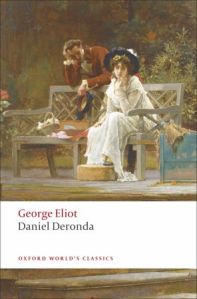
 Daniel Deronda was George Eliot’s final and most ambitious novel – even more ambitious than her most famous work, Middlemarch. Like Middlemarch, Daniel Deronda follows two main characters on parallel paths that occasionally join up. But while in Middlemarch Dorothea Brooke and Dr. Tertius Lydgate rarely encounter one another until the end – they are in different social spheres, with Lydgate being a fairly prosperous but still middle class country doctor, and Dorothea an heiress and member of the local gentry – the two focal points of Daniel Deronda, the titular Deronda and local beauty Gwendolen Harleth, are thrown into one another’s company regularly even as they follow their separate paths.
The novel opens with a memorable scene: Gwendolen, a tall, striking and classic beauty, is at the roulette table, winning spectacularly – until she feels the disapproving eyes of a stranger upon her, and begins to lose spectacularly. At a ball later that night, she asks about the stranger and is told that his name is Daniel Deronda. Gwendolen is fascinated by the handsome and enigmatic Deronda, but before she is able to finagle an introduction she receives word that her family has lost all their fortune (whoops) and she must return to England immediately. She quickly pawns a necklace to get money for the journey, but is surprised to find the necklace promptly restored to her; someone has freed it from the pawn shop and sent it back to her anonymously. With no actual evidence of her benefactor’s identity, Gwendolen suspects Deronda.
The reader is then, somewhat confusingly, whisked back in time to the previous year, when Gwendolen, her mother, and her four half sisters arrive at Offendene, a country house of middling size that is to be their new home (as it is close to the recently widowed mother’s sister and brother-in-law, who is obviously a rector, #someonegottadoit). Gwendolen quickly captivates the community and, in particular, attracts the attention of her cousin Rex Gascoigne, as well as Henleigh Grandcourt, cousin and heir to the local baronet, Sir Hugo Mallinger. Gwendolen isn’t especially interested in marriage, and she quickly throws cold water on Rex’s suit, but Grandcourt, with more to offer, is a more enticing prospect, to the degree that it promised freedom from the social constraints of singledom.
Of course marriage was social promotion; she could not look forward to a single life; but promotions have sometimes to be taken with bitter herbs–a peerage will not quite do instead of leadership to the man who meant to lead; and this delicate-limbed sylph of twenty meant to lead. For such passions dwell in feminine breasts also. In Gwendolen’s, however, they dwelt among strictly feminine furniture, and had no disturbing reference to the advancement of learning or the balance of the constitution; her knowledge being such as with no sort of standing-room or length of lever could have been expected to move the world. She meant to do what was pleasant to herself in a striking manner; or rather, whatever she could do to strike others with admiration and get in that reflected way a more ardent sense of living, seemed pleasant to her fancy.
Grandcourt has an oily and obnoxious personal secretary, Mr. Lush, who – for his own reasons – does not want to see Gwendolen marry his employer, so he engineers a meeting between Gwendolen and a figure from Grandcourt’s past, who reveals a secret about Grandcourt’s character and elicits a promise from Gwendolen never to marry the man. Gwendolen flees England for Leubronn, Germany – where she first encounters Deronda, in that memorable opening scene. Eventually, it becomes apparent that Deronda has connections to Gwendolen’s neighborhood: Deronda turns out to be something of a ward or protege of Sir Hugo, and Gwendolen wonders why she finds him so fascinating.
“I wonder what he thinks of me really? He must have felt interested in me, else he would not have sent me my necklace. I wonder what he thinks of my marriage? What notions has he to make him so grave about things? Why is he come to Diplow?”
These questions ran in her mind as the voice of an uneasy longing to be judged by Deronda with unmixed admiration–a longing which had its seed in her first resentment at his critical glance. Why did she care so much about the opinion of this man who was “nothing of any consequence”?
With no fortune left, and no prospects of anything better than a position as a governess, Gwendolen is persuaded to accept Grandcourt’s offer of marriage when he renews his pursuit of her. She does so against her scruples (which are, admittedly, limited) and against her better judgment (also limited) and the newlywed couple decamps first for Grandcourt’s stately house, where Gwendolen receives a horrifying shock (which extinguishes any affection Grandcourt may have had for her) and then, eventually for London.

Gwendolen is catastrophically disappointed in her marriage. Her expectations that she would be able to use her feminine influence over Grandcourt to right old wrongs is sadly mistaken, as Grandcourt proves more than equal to her efforts to master him. The next time Deronda encounters Gwendolen, she is a shadow of her pre-marriage self.
But a man cannot resolve about a woman’s actions, least of all about those of a woman like Gwendolen, in whose nature there was a combination of a proud reserve with rashness, of perilously-poised terror with defiance, which might alternately flatter and disappoint control. Few words could less represent her than “coquette.” She had a native love of homage, and belief in her own power; but no cold artifice for the sake of enslaving. And the poor thing’s belief in her power, with her other dreams before marriage, had often to be thrust aside now like the toys of a sick child, which it looks at with dull eyes, and has no heart to play with, however it may try.
Lest you be tempted to hate Grandcourt, George Eliot – who has to be George Eliot, after all, surprising no one who read Middlemarch – makes sure to remind you that he has a perspective, too:
And Grandcourt might have pleaded that he was perfectly justified in taking care that his wife should fulfill the obligations she had accepted. Her marriage was a contract where all the ostensible advantages were on her side, and it was only one of those advantages that her husband should use his power to hinder her from any injurious self-committal or unsuitable behavior. He knew quite well that she had not married him–had not overcome her repugnance to certain facts–out of love to him personally; he had won her by the rank and luxuries he had to give her, and these she had got: he had fulfilled his side of the contract.
(When reading the above passage, I was reminded of nothing so much as the chapter that Eliot devotes to defending the sepulchral and cold Casaubon, after spending about 300 pages persuading the reader that he is a grossly unworthy husband to the beautiful and brilliant Dorothea.)
Meanwhile, what is our friend Daniel Deronda up to? He is rescuing half of London, it seems – the saintly Deronda can’t seem to stop himself saving people from themselves. Most consequentially, he happens across a young woman on the verge of drowning herself. Deronda talks her off the riverbank, installs her with the mother and sisters of his college friend Hans, sets her up with a career as a singing teacher and drawing-room performer, and then takes it upon herself to track down her long-lost brother and mother. Meanwhile, he becomes captivated by Mordecai, a consumptive philosopher and Jewish nationalist, who is himself convinced that Deronda is going to carry on his life’s work after Mordecai’s imminent death. Between Mordecai and Mirah – the young woman Deronda saves from drowning herself, who is also Jewish – Deronda experiences a cultural awakening. He is drawn to Mordecai’s philosophy and begins to seek answers about his parentage. But as Deronda navigates his growing feelings for Mirah and his fascination with Mordecai, he has no one to turn to for support, having always been the pillar of strength for others.
Perhaps the ferment was all the stronger in Deronda’s mind because he had never had a confidant to whom he could open himself on these delicate subjects. He had always been leaned on instead of being invited to lean. Sometimes he had longed for the sort of friend to whom he might possibly unfold his experience: a young man like himself who sustained a private grief and was not too confident about his own career; speculative enough to understand every moral difficulty; yet of equality either in body or spiritual wrestling;–for he had found it impossible to reciprocate confidences with one who looked up to him.
Basically, that’s Deronda’s problem: everyone looks up to him, so he has no one to confide in. Even Gwendolen relies on Deronda as a sort of confessor and moral guide (and he does give decent advice, even though he often only has half of the story). Deronda is a little too saintly (essentially, he is Dorothea Brooke without the forbidden crush), so it’s nice to have Gwendolen – who is a sort of more complex version of Middlemarch‘s local siren Rosamund Vincy – to add a bit of salt to the narrative (and even Grandcourt, who is a gigantic jerk, is fun to read about).
Overall, I loved Daniel Deronda, although I can’t say it will replace Middlemarch as my favorite of Eliot’s novels. Deronda himself is almost annoyingly perfect, but he’s well-balanced by Grandcourt, as Mirah is balanced by Gwendolen. The parlor and country-house scenes are impeccably drawn and the London setting makes for a fun change from Eliot’s usual village territory. Daniel Deronda was a commitment, for sure, but well worth the time and energy it demanded.
 covered in flour
Pingback: Reading Round-Up: March 2020 – covered in flour