
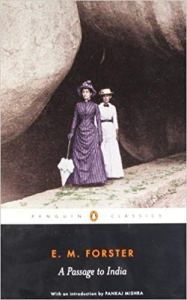
A Passage to India is E. M. Forster’s final novel – and while Howard’s End has its champions, I think this is his masterpiece. Forster loves to have his characters travel; a good portion of A Room With a View takes place abroad, of course, and so does Where Angels Fear to Tread (which I’ve not yet read, but which is on my list). In A Passage to India, Forster’s characters go even further afield, to the India of the British Raj.
The action takes place in Chandrapore, an outpost of the Raj that seems to be mostly forgettable. It doesn’t have the teeming romance of the bigger cities, nor the natural wonder of the countryside; it just is. A tight-knit English community has grown up around the local English Club, headed informally by a government official and social tastemaker known as “the Collector.” The English society in Chandrapore is tenuously balanced by a diverse array of Indians – Muslims, Hindus, and Sikhs – who don’t have much in common and don’t get along particularly well.
Into this potentially explosive mix appear two English women: Adela Quested, newly arrived with plans to marry the local magistrate, Mr Hislop, and Hislop’s mother Mrs Moore, who accompanies Adela. Both Adela and Mrs. Moore are curious travelers, and Adela expresses a wish to see the “real India.” Not Indians, mind you – India. The local English community views both Adela and Mrs Moore with an indulgent skepticism, but assumes that each will fall into line after they’ve had the chance to tourist around a little bit (and if not then, certainly after a hot season).
Early in the novel, we also meet Aziz, a Muslim doctor, who will be swept up in Adela’s wish to see the “real India” – with far-reaching consequences. Cycling into town from a gathering at a friend’s home, Aziz stops in a local mosque, where he encounters Mrs Moore for the first time. Forster’s descriptive writing is at full power:
His seat was the low wall that bounded the courtyard on the left. The ground fell away beneath him towards the city, visible as a blur of trees, and in the stillness he heard many small sounds. On the right, over in the Club, the English community contributed an amateur orchestra. Elsewhere some Hindus were drumming–he knew they were Hindus, because the rhythm was uncongenial to him–and others were bewailing a corpse–he knew whose, having certified it in the afternoon. There were owls, the Punjab mail… and flowers smelt deliciously in the station-master’s garden. But the mosque–that alone signified, and he returned to it from the complex appeal of the night, and decked it with meanings the builder had never intended. Some day he too would build a mosque, smaller than this but in perfect taste, so that all who passed by should experience the happiness he felt now.
As Aziz contemplates the fragrant night and listens to the sounds of the small city, it becomes clear that he is not alone. Mrs Moore has stumbled into the mosque with her shoes on – a major offense, and one that symbolizes the English community’s cultural tone-deafness. Aziz, ever the gracious host, instantly befriends Mrs Moore and through her, Adela. Adela, meanwhile, persists in walking the tightrope of behaving unconventionally while also being engaged to marry the local magistrate.
“People are so odd out here, and it’s not like home–one’s always facing the footlights, as the Burra Sahib said. Take a silly little example: when Adela went out to the boundary of the Club compound, and Fielding followed her. I saw Mrs Callendar notice it. They notice everything, until they’re perfectly sure you’re their sort.”
“I don’t think Adela’ll ever be quite their sort–she’s much too individual.”
“I know, that’s so remarkable about her,” he said thoughtfully. Mrs Moore thought him rather absurd. Accustomed to the privacy of London, she could not realize that India, seemingly so mysterious, contains none, and that consequently the conventions have greater force. “I suppose nothing’s on her mind,” he continued.
“Ask her, ask her yourself, my dear boy.”
“Probably she’s heard tales of the heat, but of course. I should pack her off to the hills every April–I’m not one to keep a wife grilling in the plains.”
“Oh, it wouldn’t be the weather.”
“There’s nothing in India but the weather, my dear mother; it’s the alpha and omega of the whole affair.”
Early in their stay, Adela and Mrs Moore attend a tea party at which Aziz is also present. Aziz makes a wild invitation to the English ladies to have tea at his lodgings, but in another cultural misunderstanding, discovers that they actually thought he was serious. To save face, and avoid letting the women see his humble home, he plans a picnic instead, and gathers a large group to explore the Marabar Caves, a landmark outside of town. Aziz values hospitality, and he is intent that every detail be perfect – from the elephants he engages to take the group to from the train station to the picnic spot, to the servants and the weather and the walking route. It all has to be perfect.
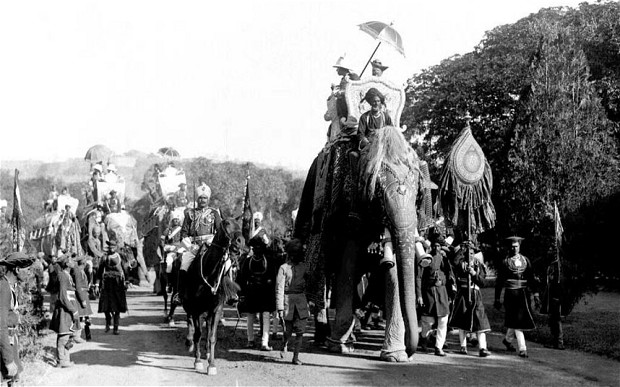
(source: telegraph.co.uk)
From the beginning, the day is a disaster, despite Aziz’s efforts. Aziz’s English friend, Professor Fielding, misses the train – a critical piece of ill luck – the guests are discontented, and a confusing encounter in the shimmering heat of the caves leads to Adela fleeing from the picnic. When Aziz arrives back in Chandrapore after the disastrous day, he is arrested and accused of assaulting Adela – and the fragile racial detente of the city erupts while the local officials strain to keep the peace.
The others, less responsible, could behave naturally. They had started speaking of “women and children”–that phrase that exempts the male from sanity when it has been repeated a few times. Each felt that all he loved best in the world was at stake, demanded revenge, and was filled with a not unpleasing glow, in which the chilly and half-known features of Miss Quested vanished, and were replaced by all that is sweetest and warmest in the private life. “But it’s the women and children,” they repeated, and the Collector knew he ought to stop them intoxicating themselves, but he hadn’t the heart.
Forster’s characters are wonderfully complicated. It would be easy to portray Adela as a monster and Aziz as an innocent victim – but Forster draws the reader into Adela’s confusion and her distress as the situation spirals out of control. It is clear that something happened to Adela in the caves, but – what? Aziz, meanwhile, does not help himself by insisting that he is innocent because he would never assault a woman as hideously ugly as Adela. (Speaking as a lawyer, here: that is not an awesome defense.) As the tension builds, it becomes obvious that no one is entirely at fault, no one is entirely blameless, and definitely no one is in control.
I loved A Passage to India. From the finely-crafted landscape details to the complex characters and the simmering tension of the courtroom scene – in which Aziz is tried for assault – every word is pitch-perfect. It also struck me that Forster’s sensitive portrayal of a community torn apart by racial tensions was well ahead of its time. Forster wrote this book in 1924, decades before Indian independence, and well in advance of rising global consciousness about race. It’s a wonderful book in any event, but when considered against the backdrop of the period in which Forster was writing, it’s a rare achievement indeed.
 covered in flour