
 Well, all I can say is, never be the heroine of a mystery. That you can avoid, if you can’t help being an accessory.
The more I experience of the worlds created by Elizabeth Gaskell, the more I love her work. While she’ll never knock my beloved Jane Austen and L.M. Montgomery off the pedestal they share, she’s stepped right over her dear friend Charlotte Bronte’s place in my affections. I’m sorry to say I clung to a teenaged prejudice against Gaskell for too long, based entirely on her responsibility for the sanitized Life of Charlotte Bronte, the very idea of which (because I haven’t actually read it) my high school self found offensive. But a few years ago I decided it was time I gave Gaskell a try, so I picked up Cranford and was captivated and delighted. Then last year, grieving a family member who had appreciated Gaskell, I turned to North and South to ease the loss, and it was just what I needed.
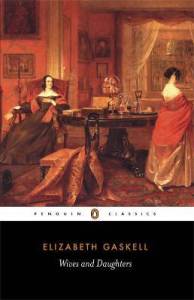
Wives and Daughters is my third Gaskell, and I think it’s my favorite so far. It’s pure joy from the first page to the last. When the story opens, we meet young Molly Gibson, daughter of a respected country doctor, on her way to her first foray into society – for a garden party at Cumnor Towers, the local seat of the Earl and Countess of Cumnor. While at the Towers, Molly falls ill – too much excitement, not enough food – and is bundled off to rest in the bedroom of the younger Cumnor ladies’ governess, a woman named Clare. Clare promises to retrieve Molly in time for her to go home, then promptly forgets that Molly exists at all. When Molly awakens, it’s dark, and she has to spend the night at the Towers – the first night she’s spent away from home, and away from her widowed father. She’s distraught and forlorn, and your heart breaks for her immediately – and you want to throttle the thoughtless Clare.
Fast-forward a few years: the teenaged Molly is just as innocent as the young lamb who found herself lost and forgotten at Cumnor Towers, but now she’s the recipient – unwittingly, though – of her first love correspondence. Mr. Gibson intercepts a letter from one of his medical students, professing his (somewhat embarrassing) undying love for Molly. Mr. Gibson panics, packs the young offender (he’s a ginger! the horror!) off to his relatives, fires the housemaid from whom he intercepts the message, and sends Molly to Hamley Hall, residence of the local squire, to be out of the way. At Hamley, Molly endears herself to the squire and his wife – especially his wife. And she develops a girlish crush on the poetic elder son of the house, Osborne, and a quiet respect and admiration for his younger brother Roger.
Meanwhile, Mr. Gibson, still in a dad-panic, decides there’s only one thing to be done: he needs to marry again, and fast. Molly clearly needs a mother, someone dependable and loving, who can guide her as she transitions from girlhood into young womanhood. It doesn’t much signify that Molly doesn’t want a stepmother intruding on her intimacy with her father – in fact, Mr. Gibson doesn’t even ask her opinion. (Mr. Gibson is a man of many wonderful qualities, but his one major failing is a tendency to have knee-jerk reactions and freak out and make really dumb decisions.) In his search for a steadying influence on Molly (who doesn’t actually need steadying) Mr. Gibson chooses the worst possible candidate: one Hyacinth Kirkpatrick, a pretentious social-climbing widow, who in her more youthful days was none other than the self-centered Clare – the very same, whose forgetfulness was at the root of Molly’s one and only traumatic childhood memory. Whoops!
Mrs. Kirkpatrick, who sees a good thing and quickly becomes Mrs. Gibson, is a terrible choice for a stepmother. She’s hardly the sobering influence Mr. Gibson has in mind. Molly dreads her entry into the family and suffers a great deal of heartache around her father’s wedding, and it’s immediately apparent from the new Mrs. Gibson’s tone-deafness when it comes to her stepdaughter (insisting on being called “Mamma,” stripping the house of Molly’s memories of her real mother…) that Mr. Gibson has made an awful mistake. But the reader is fortunate, because Mrs. Gibson, with all her pretentions and aspirations, is one of the best comedic characters I’ve ever read, and she also ushers the blooming Cynthia into the story.
Cynthia is Mrs. Gibson’s daughter from her first marriage. She’s everything Molly is not – flirtatious to Molly’s quiet serenity, gaudily beautiful to Molly’s restrained elegance, underhanded to Molly’s straightforwardness and forthrightness. But Molly immediately adores Cynthia, and Cynthia, to her credit, adores Molly. And somehow – it works. Molly is Cynthia’s staunch ally, and Cynthia is Molly’s devoted friend, and their relationship quickly becomes as close as if they were really sisters – even when Cynthia catches the eye of Roger Hamley, which Molly discovers she doesn’t quite appreciate, somehow.
Cynthia looked lovelier than ever to him for the slight restriction that had been laid for a time on their intercourse. She might be gay and sparkling with Osborne; with Roger she was soft and grave. Instinctively she knew her men. She saw that Osborne was only interested in her because of her position in a family with whom he was intimate; that his friendship was without the least touch of sentiment; and that his admiration was only the warm criticism of an artist for unusual beauty. But she felt how different Roger’s relation to her was. To him she was the one, alone, peerless. If his love was prohibited, it would be long years before he could sink down into tepid friendship; and to him her personal loveliness was only one of the many charms which made him tremble with passion. Cynthia was not capable of returning such feelings; she had too little true love in her life, and perhaps too much admiration to do so; but she appreciated this honest ardour, this loyal worship that was new to her experience. Such appreciation, and such respect for his true and affectionate nature, gave a serious tenderness to her manner to Roger; which allured him with a fresh and separate grace. Molly sat by, and wondered how it would all end, or rather, how soon it would all end, for she thought that no girl could resist such reverent passion; and on Roger’s side there could be no doubt – alas! there could be no doubt.
It’s worth mentioning the relationship between Osborne and Roger, as it parallels the relationship between Cynthia and Molly in many ways. Osborne and Roger are as different as two brothers can be – yet once again, it works. Their genuine affection for one another, as with Cynthia and Molly, overcomes their differences in personality. Roger steadfastly loves and supports his brother through any number of troubles, and it’s beautiful.
Because Osborne does have some troubles – or more to the point, some secrets. And so does Cynthia. Molly becomes party to both of their secrets, and she is resolved to help Cynthia out of a “scrape” that the latter has been concealing. Help she does, but…
Scandal sleeps in the summer, comparatively speaking. Its nature is the reverse of that of the dormouse. Warm ambient air, loiterings abroad, gardenings, flowers to talk about, and preserves to make, soothed the wicked imp to slumber in the parish of Hollingford in summer-time. But when evenings grew short, and people gathered round the fires, and put their feet in a circle – not on the fenders, that was not allowed – then was the time for confidential conversation!
Molly is observed undertaking some actions to help put Cynthia’s life in order, and her well-intentioned comings and goings are misconstrued and misinterpreted by the idle ladies of Hollingford. And then – as Gaskell puts it – Molly finds a champion, in Lady Harriet Cumnor, one of the best secondary characters in the book. (Side note: I’d like to read a book starring Harriet as a lady adventurer. She and the fabulous Miss Dunstable, of Trollope’s Doctor Thorne, could go mountaineering together, or maybe excavate some tombs like Victorian lady Indiana Joneses. Will someone please write that? Perhaps I’ll have to.) The quick-witted Lady Harriet, overhearing her parents’ gossiping about Molly, immediately puts two and two together, figures out what’s really going on, and single-handedly saves Molly’s reputation in the fearless way that only a woman who knows she’s on a high enough pedestal to have nothing to fear from gossips can do. But no sooner is Molly’s reputation on the mend, than tragedy strikes – and that, I won’t divulge, because you need to read Wives and Daughters and let Elizabeth Gaskell spin this tale for you.
Wives and Daughters should be more widely read – for the beauty of the language, the diversion of the story, and the wonderful characters. And of course, the great tragedy of the book is that it’s unfinished – Gaskell died suddenly, just before writing the last chapter. But the reader knows how it’s all going to end – there’s only one possible outcome at that point. I’ll let you work it out for yourself.
Team Gaskell, amirite?
 covered in flour
Now I want to pull this off my shelf and reread it. If you ever write the book about the lady adventurers I will purchase the first copy!
You can be my beta-reader!
Pingback: Reading Round-Up: November 2019 | Covered In Flour
What a great review! I just finished W & D and looooved it! I watched the BBC adaptation almost 10 years ago, which is how I first heard of Gaskell, but I am not sure why it took me this long to finally read it. I read Cranford and North and South last year, both wonderful as well. I agree: I wish she was more widely read!
Here is my review, if interested! https://elle-alice.blogspot.com/2021/03/classics-club-wives-and-daughters.html
Hi Elena! Thanks for sharing your review – I will definitely check it out! I am glad you loved W&D as well; I need to watch that BBC adaptation. I think Cranford is still my favorite Gaskell, but it’s been such fun to work my way through her library!