
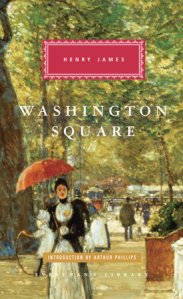
 The best word to describe Catherine Sloper would be “stolid.” The only daughter of a wealthy doctor, Catherine is an heiress and should be a sought-after socialite – but she isn’t. Tall, plain, and painfully shy, not especially witty or brilliant, Catherine’s one great quality (aside from her expectation of a great deal of money) is her constancy and steadfastness. Unfortunately, since steadfastness is, by definition, not especially flashy, Catherine’s value is largely unappreciated by the people closest to her.
Catherine lives with her father, Doctor Sloper, and his widowed sister, Lavinia Penniman. The doctor is a caustic and sarcastic man – he can be very funny, but he can also be very cruel (and enjoy it). Aunt Penniman is flighty and impulsive, and when a young fortune-hunter sets his sights on Catherine (and her inheritance), Aunt Penniman casts the two as the stars in her own private romantic drama, with herself as the puppetmaster.
Mrs. Penniman delighted of all things in a drama, and she flattered herself that a drama would now be enacted. Combining as she did the zeal of the prompter with the impatience of the spectator, she had long since done her utmost to pull up the curtain. She, too, expected to figure in the performance – to be the confidante, the Chorus, to speak the epilogue. It may even be said that there were times when she lost sight altogether of the modest heroine of the play in the contemplation of certain great scenes which would naturally occur between the hero and herself.
The “hero” of Aunt Penniman’s imaginings is Morris Townsend, whom Catherine meets at an engagement party. Morris is handsome, charming and witty – but has nothing else, really, to recommend him. He is lazy and indolent, and it’s obvious to everyone with clear eyes that he’s only interested in Catherine’s money. The only people who don’t see right through Morris are the infatuated heiress herself, and her silly aunt.
Catherine’s father is not deceived, but he’s not especially active in separating the two lovers either – and therein lies the central conflict of the novel. Doctor Sloper does not want a lazy grifter for a son-in-law – quite understandably. He’s not particular about Morris having money or not; after all, Doctor Sloper was once poor before he married a wealthy heiress himself. But where Doctor Sloper had ambition and intellectual interests, Morris’s sole ambition seems to be to marry a rich woman and then spend her money. But Doctor Sloper’s character flaw, which will get in the way of his protecting his daughter’s interests, lies in his general lack of respect for women.
The doctor eyed [Morris’s sister, Mrs. Montgomery] a moment. ‘You women are all the same! But the type to which your brother belongs was made to be the ruin of you, and you were made to be its handmaids and victims. The sign of the type in question is the determination – sometimes terrible in its quiet intensity – to accept nothing of life but its pleasures, and to secure these pleasures chiefly by aid of your complaisant sex. Young men of this class never do anything for themselves that they can get other people to do for them, and it is the infatuation, the devotion, the superstition of others that keeps them going. These others, in ninety-nine cases out of a hundred, are women. What our young friends chiefly insist upon is that someone else shall suffer for them; and women do that sort of thing, as you must know, wonderfully well.’
Unfortunately, since he doesn’t respect his daughter, Doctor Sloper waits too long to deal with the Morris situation, and by the time he actually takes an interest – even then more of a curious interest, because he’s intrigued by the question of whether Catherine will “stick” – it’s too late to break them up – at least, without permanently damaging Catherine’s relationship with her father. Catherine is implacably devoted to Morris, and he’s determined to wait out the doctor, with Aunt Penniman’s incorrigible encouragement. Perhaps if Doctor Sloper respected women more (he strikes me as a less-charming Mr Bennet, if Mr Bennet sort of placidly disliked Lizzy) he might have made the situation better, not worse.
In the end (spoiler alert!) no one ends up satisfied – which struck me as about the right result. Both Doctor Sloper and Morris were dreadful people in their own ways (if they lived in 2019, they’d both be horrible mansplainers), Aunt Penniman was the worst sort of adult who never actually grew up, and even Catherine took steadfastness too far and turned it to stubbornness. Catherine was by far the most sympathetic character of the book, but by the end, I wanted to slap her, too.
It may seem as if I disliked Washington Square – but I didn’t. I actually liked it quite a lot. The characters were intensely real, the scene-setting was wonderful, and the writing was delightful and witty. Doctor Sloper, when he wasn’t being awful, and Catherine, when she wasn’t being maddening, could really be quite funny. I loved watching Catherine’s courage and humor develop, and while I’d have liked to see a happier ending for her, James gives the story the ending that is fitting. I’ll definitely be seeking out more Henry James novels.
Have you read any Henry James?
 covered in flour