
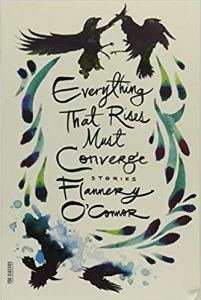
 The older I get, the better I know what I want to read, and the less patience I have with books that just don’t give me what I’m looking for. My reading time is limited – curtailed by work, parenting, other responsibilities, not to mention that there are other things I want to do in the little bit of spare time I have. So I’m choosy about the books I spend time with. When I read a classic, it’s because they’re generally dependable for me – I know I’m going to enjoy the book and find that the reading experience was worth my time. But there are exceptions to every rule.
It pains me to say this, because I’ve been meaning to read Flannery O’Connor for years, but – I did not like Everything that Rises Must Converge. I went into it knowing nothing about what I’d be getting, except that O’Connor wrote a lot about race and religion – but just based on that, I figured I’d find plenty in the book to engage. After a few of the stories, though, I realized that there was a recurring theme beyond race, morality, or faith – and it was [spoiler alert] horrible people dying horrible deaths.
The first story, the titular “Everything that Rises Must Converge,” was not so bad. A reprehensible woman and her self-righteous (but also reprehensible in his own way) son ride the bus. The woman, a casual racist, has an encounter with an African-American fellow transit rider, in which she exposes how ignorant and tone-deaf she is. The African-American woman hits the reprehensible woman with her purse, and the reprehensible woman promptly has a stroke and dies. And I found myself not even a little bit sorry.
That was just a foretaste. The deaths got gorier and the characters more reprehensible as the stories marched grimly on – and I stopped paying close attention, mostly rushing through to get to the end. (I’d have abandoned this book after the third story, “A View of the Woods,” had it not been on my Classics Club list.) Sometimes O’Connor strayed from her main theme and delved into bad things happening to kids, which was even worse than horrible people dying horrible deaths. In general, what I can say is: this book was very, very, very, very much not for me.
Since I was committed to reading it, I made a superhuman effort to appreciate O’Connor’s spare, elegant prose, the construction of her stories, and the witty descriptions she often assigned to her characters. For instance, on the main character in “Greenleaf,” O’Connor muses:
She thought the word, Jesus, should be kept inside the church building like other words inside the bedroom. She was a good Christian woman with a large respect for religion, though she did not, of course, believe any of it was true.
That just cuts right to it, doesn’t it? Or the county official who marries two characters in “Parker’s Back,” and could be any disgruntled municipal worker anywhere:
The Ordinary was an old woman with red hair who had held office for forty years and looked as dusty as her books. She married them from behind the iron-grill of a stand-up desk and when she finished, she said with a flourish, “Three dollars and fifty cents and till death do you part!” and yanked some forms out of a machine.
I did appreciate the writing and the characterization, when the characters weren’t being despicable or being murdered or murdering someone else. And every so often I saw flashes of grace – a character who suddenly realizes that all of her meticulously defined social classes will be equal before God, for instance. But those moments were not enough to make this a good reading experience for me. I’m sure it’s me, and that I’m missing some vital message here – but my job and parenting life are demanding enough as it is, and when I read I want to be uplifted. I’ll willingly struggle along for a bit, but at the end of the day I want to close a book feeling joyful – or if not joyful, exactly (looking at you, Edith Wharton) at least as though, when the final accounting comes, I’ll be glad to have given that time to that book. I didn’t feel that for Everything that Rises Must Converge. Again – it’s probably me. But this book just wasn’t for me. I can’t see myself picking up any of O’Connor’s other work or recommending it to friends.
What do you think of Southern gothic fiction?
 covered in flour