
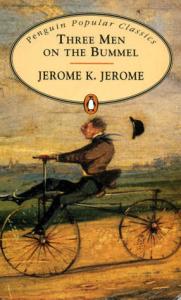
 Three Men on the Bummel is the sequel to Jerome K. Jerome’s hilarious Three Men in a Boat. In Bummel, the same set of three friends – J., Harris and George – convene for another madcap vacation. On their first adventure, they punted the Thames from Kingston to Oxford, encountering all kinds of characters, engaging in various hijinks, and bickering companionably all the while. This time, they’ve decided to work out their energies – pent-up from days spent toiling in their various Victorian offices – via a bicycle tour through Germany.
A few things have changed since the boating holiday. George remains a bachelor, but Harris and J. have both acquired wives and children, and the reader is treated to a particularly funny chapter in which the men strategize about how to get their wives to agree to their planned journey. They’re successful, of course, or the book would have ended around chapter three… but the conversations don’t go entirely as planned and while Harris and J. are quite agreeably pleased with the results, the reader is left with a sneaking suspicion that Mrs. Harris and Mrs. J. had something up their sleeves all the while.
The wives’ permission secured, the fellas set to planning their trip and discuss overhauling their bicycles, in another of the funnier scenes from the book. J. is absolutely determined not to have his bicycle overhauled, feeling strongly that you can either overhaul a bicycle or you can ride it, but you can’t do both, and for his part, he prefers to ride.
I have had experience of this ‘overhauling.’ There was a man at Folkestone; I used to meet him on the Lees. He proposed one evening we should go for a long bicycle ride together on the following day, and I agreed. I got up early, for me; I made an effort, and was pleased with myself. He came half an hour late: I was waiting for him in the garden. It was a lovely day. He said:—
‘That’s a good-looking machine of yours. How does it run?’
‘Oh, like most of them!’ I answered; ‘easily enough in the morning, goes a little stiffly after lunch.’
He caught hold of it by the front wheel and the fork, and shook it violently.
I said: ‘Don’t do that; you’ll hurt it.’
I did not see why he should shake it; it had not done anything to him. Besides, if it wanted shaking, I was the proper person to shake it. I felt much as I should feel had he started whacking my dog.
He said: ‘This front wheel wobbles.’
I said: ‘It doesn’t if you don’t wobble it.’ It didn’t wobble, as a matter of fact–nothing worth calling a wobble.
He said: ‘This is dangerous; have you got a screw-hammer?’
I ought to have been firm, but I thought that perhaps he really did know something about the business. I went to the tool shed to see what I could find. When I came back he was sitting on the ground with the front wheel between his legs. He was playing with it, twiddling it round between his fingers; the remnant of the machine was lying on the gravel path beside him.
He said: ‘Something has happened to this front wheel of yours.’
‘It looks like it, doesn’t it?’ I answered. But he was the sort of man that never understands satire.
In further preparation for their trip, they discuss the schedule and make some very high-minded resolutions about getting early starts every day, including at the beginning of their trip, leading to my favorite chapter of the book. George spends the final evening before departure at Harris’ house, and J. muses on the dangers of being a houseguest in a home with children. I read the chapter on the Metro and attracted quite a few stares with my weeping, which was due to a combination of mirth and desperate resignation: it seems that Victorian children were just as apt to get up before dawn and make a ruckus as present-day children are. The more things change, the more they stay the same.
I knew that if he slept at ‘Beggarbush’ he would be up in time; I have slept there myself, and I know what happens. About the middle of the night, as you judge, though in reality it may be somewhat later, you are startled out of your sleep by what sounds like a rush of cavalry along the passage, just outside your door. Your half-awakened intelligence fluctuates between burglars, the Day of Judgment, and a gas explosion. You sit up in bed and listen intently. You are not kept waiting long; the next moment a door is violently slammed, and somebody, or something, is evidently coming downstairs on a tea-tray.
‘I told you so,’ says a voice outside, and immediately some hard substance, a head one would say from the ring of it, rebounds against the panel of your door.
By this time you are charging madly around the room for your clothes. Nothing is where you put it overnight, the articles most essential have disappeared entirely; and meanwhile the murder, or revolution, or whatever it is, continues unchecked. You pause for a moment, with your head under the wardrobe, where you think you can see your slippers, to listen to a steady, monotonous thumping upon a distant door. The victim, you presume, has taken refuge there; they mean to have him out and finish him. Will you be in time? The knocking ceases, and a voice, sweetly reassuring in its gentle plaintiveness, asks meekly:
‘Pa, may I get up?’
You do not hear the other voice, but the responses are:
‘No, it was only the bath–no, she ain’t really hurt,–only wet, you know. Yes, ma, I’ll tell ’em what you say. No, it was a pure accident. Yes; good-night, papa.’
Then the same voice, exerting itself so as to be heard in a distant part of the house, remarks:
‘You’ve got to come upstairs again. Pa says it isn’t time yet to get up.’
Eventually, the trio departs for Germany and, despite protestations that this is not a travel book and the reader would do well to look elsewhere for detailed descriptions of scenery, we are treated to some lovely passages about the cities the friends tour during the trip. As expected, there are more shenanigans – such as an encounter with a man with a watering hose while out cycling in the countryside and a scheme to convince George to give up drinking German beer.
I found Three Men on the Bummel enjoyable, for the most part, but it suffered in comparison to its predecessor. Three Men in a Boat felt really fresh and new; Bummel felt like a sequel seeking to capitalize on the success of the prior book. (I have no idea if that’s true, but it did read that way.) It became repetitive, and there were certain tropes and scenes that have not aged well. These flaws took the book from a four-star read to a three-star read for me.
I still liked it. It’s hard not to like a visit with George, Harris and J., and it’s hilarious to eavesdrop on their bickering. There are some truly genius throwaway likes (such as when J. nonchalantly notes that when his Uncle Podger tries to leave the house in the morning, he’s always surrounded by a gaggle of children, and the child with the stickiest face is “always the most affectionate.”). But for future Victorian hilarity, I think I’ll revisit Three Men in a Boat.
Three Men on the Bummel, available here (not an affiliate link).
 covered in flour