
 Old New York is a collection of four novellas, each telling a story of a different decade in New York society. In False Dawn, Wharton explores the stormy relationship between a son and his domineering father, and the bittersweet consequences when the son attempts to stretch his wings. The Old Maid portrays two cousins who share a heartbreaking secret, and The Spark is a portrait of a wealthy banker who is both admired and ridiculed. New Year’s Day, the final novella in the collection, was – I thought – the best of the set. It tells the story of a married woman who is engaged in an affair, and how her efforts to keep the affair secret after she and her lover are spotted fleeing a hotel fire – but there is a surprising twist I won’t tell you about, because I don’t want to spoil this wonderful book.
Wharton classes each of the novellas as a story of a different decade – the 1840s, 1850s, 1860s and 1870s. By virtue of this march through time, certain characters and families reappear – Sillerton Jackson, for instance, is a minor character who first appears in The Old Maid (1850s) as a potential suitor to one of the three principal characters. By New Year’s Day (1870s) he is a venerable and inscrutable old gentleman who spies the main character, Mrs. Hazeldean, in her guilty escape from the burning Fifth Avenue Hotel. There are recurring references to the same old New York families in both False Dawn and The Old Maid, as well.
As I often do when reading a collection that is comprised of multiple stories, I had a range of reactions. I didn’t really get the point of The Spark, the 1860s contribution. The summary promised a tale of a young man whose moral retribution is “sparked” by a chance encounter with Walt Whitman, but that didn’t really happen. One of the characters does encounter Whitman in an Army hospital during the Civil War, but it’s not a centerpiece of the narrative; most of the action takes place in the 1890s (confusingly, since The Spark is supposed to be a story of the 1860s) and centers upon the wealthy banker, Hayley Delane, taking in his ailing father-in-law. There didn’t seem to be much of a plot and the characters didn’t engage me; The Spark was the shortest of the four novellas and the least developed.
False Dawn and The Old Maid presented more of a contrast and showcased Wharton’s masterful writing. False Dawn was particularly evocative in its description of the Raycie family’s grand Long Island estate – I could see the house lights glittering on the Sound and feel the summer heat. And The Old Maid presented a beautiful, bittersweet portrayal of two women’s desperate bargain in order to avoid scandal.
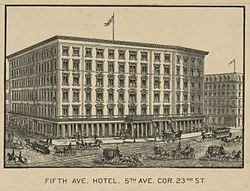
But New Year’s Day was the crown of the collection. The novella opens with a young man being chastised by his mother for speaking the name of Lizzie Hazeldean in front of his impressionable sisters. Because Lizzie Hazeldean was bad – she met men in the Fifth Avenue Hotel – or so the narrator’s mother claims. The action then quickly jumps to a winter’s day on Fifth Avenue in the 1870s. The Fifth Avenue Hotel is ablaze, and it seems that half of New York society is comfortably watching the conflagration from behind the draperies of a grand house across the street. Out of the burning hotel, nearly but not quite lost in the crowds, run Lizzie Hazeldean and Henry Prest, and New York society is scandalized. Over the course of the day, Mrs. Hazeldean agonizes over whether her acquaintances recognized her in the press of people and whether her invalid husband, who had dashed out to see the fire engines, had spotted her. There is a twist, which I won’t reveal, but it takes the novella from a breathless tale of scandal, wonderful on its own, into truly poignant and tragic territory. I loved it.
Old New York, by Edith Wharton, available here (not an affiliate link).
 covered in flour
Pingback: It’s Nugget’s Birthday! What Are You Reading? (March 11, 2019) | Covered In Flour
Pingback: Reading Round-Up: March 2019 | Covered In Flour