
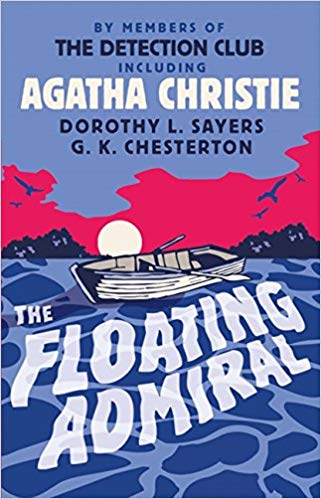
 In his introduction to The Floating Admiral, Simon Brett describes the book as a sort of parlour game – as all the best detective novels are, really. But even amongst golden age crime novels, The Floating Admiral is unique, having been team-written by a collection of mystery-spinning luminaries the likes of which the literary world never saw before and likely will never see again: the original Detection Club.
A word about the Detection Club, for those who are unfamiliar: it was a sort of booze-soaked writing society, made up of everyone who was anyone in the golden age crime-writing world. Agatha Christie was a member; so were Dorothy L. Sayers, Anthony Berkeley, G.K. Chesterton and John Rhode, among others. They met on a regular but infrequent basis and their main purpose was to eat good food, drink, and talk about writing. (How do I join?) Eventually, it became clear that they needed to make some money to continue funding the eating of good food and the drinking of booze, so – bunch of writers that they are – they hit on the idea of writing a book together. The result was The Floating Admiral.
The concept is simple: each club member (at least, each member who was involved in the project) wrote one chapter, then passed the whole packet of papers on to the next victim… errrr… writer. Canon Victor L. Whitechurch started them off, laying the basic premises for the crime in a chapter entitled “Corpse Ahoy!” – in which we meet the corpse, one late Admiral Penistone; the sleuth, Inspector Rudge; and a few other cast members. Tidal soothsayer and local grouch Neddy Ware discovers the body of the Admiral, a relative newcomer to the neighborhood, stabbed to death in the Vicar’s boat (because why not?) and bobbing around in Neddy’s favorite secret fishing spot, and we’re off to the races. Each member of the club contributes some clues and some red herrings, every chapter ends on a cliffhanger (no one could resist, it seems), at least five suspects flee to London, and it’s all good fun.
None of the writers knows what they’re getting before they receive the sheaf of papers for their turn at the tiller, and once they turn the story over to the next writer it’s out of their hands. Anthony Berkeley – whose name will be familiar to fellow devotees of the British Library Crime Classics series; I know you’re out there – writes the aptly titled final chapter, “Clearing Up the Mess” and G.K. Chesterton contributes a prologue that ties everything together after the murder is puzzled out in full; Chesterton was the only contributor who had the full solved puzzle to work from before he started writing. John Rhode – another BL Crime Classics frequent flyer – Sayers, and Christie all contribute chapters, and I like to think that I could have attributed Christie’s chapter, in particular, to the author – I’ve read enough of her work to be fairly familiar with her writing style.
For instance, Christie relies heavily on dialogue to introduce new clues and plot points, and it’s apt that her chapter is entitled “Mainly Conversation.” Because Aggie’s gotta Ag, she introduces the Inspector to the local busybody, who gives him some useful information in the midst of telling him all the neighborhood gossip and her own theories about the crime:
‘A train to catch,’ mused the Inspector.
‘That would be the 11.25 I expect,’ said Mrs Davis. ‘The up train for London. Six in the morning it gets there. But he didn’t go by it. What I mean is, he couldn’t have gone by it, because if he had, he wouldn’t have been lying murdered in the Vicar’s boat.’
And she looked at Inspector Rudge triumphantly.
Anthony Berkeley gets the fun job of unraveling all the clues, discarding the red herrings, and revealing the solution to the mystery. But once Berkeley has revealed the official solution, everyone else gets in on the fun in the appendix, as each writer contributes their own scheme for solving the puzzle and ending the novel. And if the novel itself was absurd, the appendices are straight-up loony tunes. Various people are in disguise, there is tomfoolery with an inheritance and a hurried marriage, the Vicar is an accessory before the fact, the Vicar is an accessory after the fact, it’s a team effort, it’s a crime of passion!
Here’s the thing: as a piece of writing goes, The Floating Admiral isn’t awesome. As is to be expected when thirteen (!!!) people are involved, it’s weirdly disjointed, nothing makes much sense, the plot is all over the place and the whole experience is disorienting. But as a game or a puzzle, it’s a darned fun experiment and a delightfully silly way to spend a few hours. I knew there was no way I’d be able to solve the puzzle, since none of the writers even knew how it was going to work out, so I just buckled in and enjoyed the silliness – and what enjoyable silliness it was.
The Floating Admiral, by the Members of the Detection Club, available here (not an affiliate link).
 covered in flour
It was with a feeling of great excitement that I bought the Floating Admiral several years ago.
Yet I was just as disappointed as you.
Yeah – it wasn’t awful, just not exactly a literary masterpiece. I suspected that would be the case. As a thought experiment and a fun game, I thought it was a joy.
Pingback: The Fall List 2018: Recap | Covered In Flour