
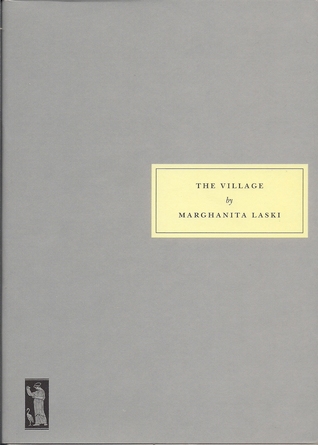
 There comes a point in the life of a classic literature fan where – while you may not have completely worked your way through “the canon,” such as it is – you start looking for the different, the less-known, the forgotten. I’ve always felt a strong connection to classics by women – your Jane Austen, your L.M. Montgomery, your Edith Wharton, your Bronte sisters, your Elizabeth Gaskell, etc. – so it was only a matter of time before I discovered Persephone Books, an independent publishing house based in London which has built a following through its dedication to printing long-neglected classics by mostly women writers, many of whom I’d never heard of before discovering these lovely dove grey volumes. Any new convert to the Persephone way learns that there are two authors in particular who enjoy a spot atop the pyramid of Persephone’s stable of authors – Dorothy Whipple and Marghanita Laski.
I’ve read one Whipple – Greenbanks – and loved it, so I thought I’d better give Laski a go. One thing about Laski is that no two of her books are alike. They vary in subject, tone and style. So I suspected that I might like some better than others, and decided to start with The Village, which seemed a likely success for me – and it was.
In the opening scene of The Village, victory has just been declared in the European phase of World War II. The war, of course, was still raging in the Pacific, but for the residents of Priory Dean, V-E Day effectively meant the end to hostilities. Refugees would be headed back to London – if they weren’t already – the threat of German bombs was over, and deployed local boys would soon be straggling home, if they had survived. On the first night of peacetime, there’s no curfew, there are bonfires and dancing in the streets. And as the celebrations whirl through the village, Wendy Trevor and Edith Wilson wend their way to their night’s watch. There’s really no need for them to scout through the evening, since the war is over. But both women are oddly reluctant to let their wartime duties go. They come from different stations in life – Wendy belongs to impoverished gentry, and Edith to the working class, lacking in social graces but better funded than the Trevors and their like. Edith used to “do for” the Trevor family, and she and Wendy both know that their friendship, forged in the crucible of wartime, is now going to have to end. Edith will be sticking with her kind, and Wendy with hers. But they both crave one last evening of companionship before returning to their respective stations in life.
Wendy said with a half-laugh, half-sob, ‘Listen, the dance music’s stopped. Edith,’ she sad, mopping her eyes, twisting her handkerchief in her hands. ‘I don’t know how to apologise. I don’t know what came over me, making an exhibition of myself like that.’
‘There’s nothing to apologise for at all,’ said Edith. ‘We’re all of us that tired and overwrought these days anyway, and if you can’t have a good cry here tonight I don’t know when you can.’ She added almost casually, her face half-turned away, ‘I lost a baby too, you know. A little girl, mine was. It was my first, too.’ She sat down beside Wendy, and again the two women sipped their tea, talking now in soft relaxed voices of the children when young, of their husbands, their parents, remembering the little things that had made up their lives, made them what they were. Neither had ever talked like this to anyone before and never would again.
At last Wendy glanced up at the window and it was light. On a single impulse they both got up and went to the door, looking out at the village in the early morning light, at the Norman church and Dr Gregory’s long Georgian house on the north side of the Green, the dark cedars that spread over the wall from Miss Evadne’s garden on the short side, at the ugly new shops flanking the village hall and closing the triangle around the Green. The air was cool and sweet and no one was about. It was the first day after the war.
Unbeknownst to Wendy and Edith, however, they’ll soon be thrown back together. The Trevors – Major Gerald and Wendy – have two daughters, for whom they have scrimped and sacrificed to provide the best education. Margaret, the eldest, is concluding school and the education seems to have been wasted on her. She dreams of marriage and motherhood. Unfortunately, the only son of the local gentry, Roger Gregory, is covered in acne and made even more unattractive by his unpleasant attitude. After an embarrassing rejection at a local dance, however, Margaret finds herself back in the orbit of her childhood companion, Roy Wilson, with whom she used to play when his mother – Edith – cooked and cleaned for the Trevors. Roy and Margaret drop back into their easy companionship and – I’m sure you see where this is going – are soon in love.
‘Oh, Roy,’ said Margaret, in an anguish of longing, and he demanded fiercely, ‘Margaret, you must marry me. Say you’ll marry me.’
‘Oh, Roy,’ she repeated, and then he bent his head to hers and they kissed in bliss.
At last, he lifted his head and looked into her eyes. ‘I love you,’ he said despairingly and Margaret sighed, ‘Oh, Roy, I love you too. I love you,’ and he kissed her again, but this time they clung together for fear of loss and kissed in desperation.
When this kiss ended, their lips were trembling and their faces troubled. ‘Oh, Margaret, I need you so much,’ whispered Roy. ‘You’re what I’ve always wanted, we could be so happy–‘ He buried his face in her neck, the touch of his lips bringing to both a warm excited content.
Tentatively Margaret’s hands began to touch his neck, to stroke his hair. ‘Let’s go on pretending,’ she said softly, ‘do let’s go on pretending. Tell me about the rest of the house.’
He dragged himself upright and leant back against the tree, pulling her against him so that she leant on his shoulder, his arms around her and his other hand playing with her hands. ‘There’d be a hall with a barometer,’ he said, ‘and I’d tap it to see if I was going to dig in the garden or go off to the pub.’
‘I’d come to the pub with you,’ said Margaret tenderly.
Roy and Margaret attempt to keep their romance secret, but in a small village, no gossip stays secret for long. When the village gentry learn of Margaret’s affection for Roy and the young couple bravely declare their intention to marry, the Trevors are properly horrified by this unprecedented intermingling of classes. Wendy, expecting her night’s watch companion to be as unsettled by the union as she is, appeals to Edith to help her minimize the damage. To Wendy’s chagrin, Edith insists on being baffled as to what’s so shameful about marrying her upright, kind, gainfully-employed son. And so the union between the daughter of impoverished gentry and the son of the upwardly mobile working class becomes the first test of a new social order.
There’s a lot in this book. My one complaint was that the book’s central theme was sometimes a bit unsubtle. It did feel, on occasion, as if Laski didn’t trust her readers enough to draw their own conclusions, and instead she felt the need to beat us over the head with her social theories. The result was that the action was sometimes predictable. But it was easy to overlook the occasional ham-handedness of the narrative because the village and its denizens were so alive. There were a number of side plots that I haven’t addressed at all, and my favorite was the collective aneurysm of the gentry when a successful shopkeeper sells her business, buys a home in the “nice” section of town, and starts wearing tweeds:
To Miss Porteous’s immense surprise, Miss Moodie, when she came to the door, was seen to be wearing a tweed suit. Miss Porteous had never through of it that way before, but tweed suits, in Priory Dean, were definitely gentry-wear. In the past Miss Moodie had always been seen in the unnoticeable stockinette dress and cardigan of the respectable tradeswoman; she might, indeed, in these days even have worn a skirt and a hand-knitted jumper; but never, Miss Porteous obscurely felt, a tailored tweed jacket. Why, now, with her smooth grey hair in the neat bun above this unassailable uniform, she looked just like anyone else, not even very unlike Miss Porteous herself, and it was the confusion she was feeling that led her, without thinking, to cross the threshold when Miss Moodie said, ‘Do please come in, there’s really a nip in the air today. You’d hardly think it’s really June,’ and then to walk into the sitting-room when Miss Moodie turned the oxydised copper handle on the oak-grained door.
It’s the well-drawn village and the living, breathing characters that takes The Village from a heavy-handed tale of social upheaval to a classic. I loved the peeks into the kitchens and drawing-rooms of another age, I was righteously angry when Roger Gregory (twice!) snubbed Margaret Trevor, and I cheered for Margaret in her new-found strength to defy her social circle and marry the man she loved – with the encouragement of an unlikely source, and I’m not going to tell you whom, because you really should read The Village.
This review is part of my Classics Club Challenge.
 covered in flour