
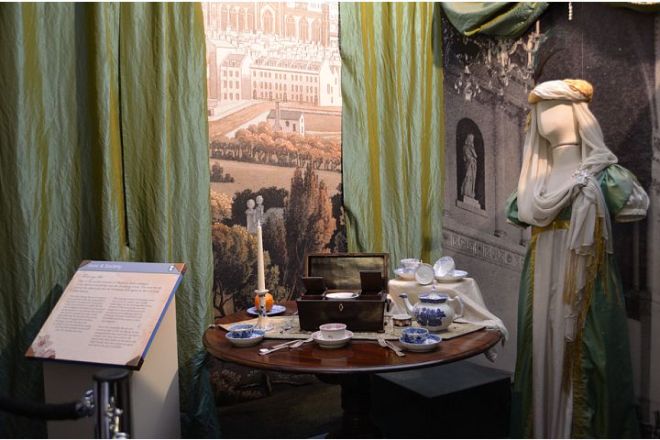
She had never boasted either beauty or cleverness. Her youth had passed without distinction, and her middle of life was devoted to the care of a failing mother and the endeavor to make a small income go as far as possible. And yet she was a happy woman, a woman whom no one named without goodwill. It was her own universal goodwill and contented temper which worked such wonders. She loved everybody, was interested in everybody’s happiness, quick-sighted to everybody’s merits; thought herself a most fortunate creature, and surrounded with blessings in such an excellent mother and so many good neighbors and friends and a home that wanted for nothing. The simplicity and cheerfulness of her nature, her contented and grateful spirit, were a recommendation to everybody and a mine of felicity to herself.
~ Emma
There is a certain variety of spinster that can be found peopling many a village in the dappled realm of imagination that is English literature. Never flush with cash, their lives could be called simple to the point of dullness, yet they manage to live with a gentility and serenity that is almost too genteel and serene to be believed. Spinsterhood, in Regency, Georgian, and Victorian times, was something of a dangerous occupation. In a world where men held all the cards and all the power, women needed a man’s protection – husbands, fathers, or cousins or brothers who understood their relation of power and the responsibility that it ought to entail – in order to live even somewhat comfortably, an unnerving and perilous dynamic that female writers of the eighteenth and nineteenth centuries routinely explored.
Jane Austen’s Miss Bates is often held up as the quintessential example. Miss Bates is poor. She lives with her mother, the elderly and ailing Mrs. Bates, and the two ladies manage to scrape along and make ends meet somehow. They live for visits from niece and granddaughter Jane Fairfax, and for the companionship of their neighbors. Yet their relatively unprivileged position makes it all too easy for Emma – inconsiderate, selfish Emma – to demean and ridicule Miss Bates. In condescendingly mocking Miss Bates, Emma thoughtlessly embodies the heedless cruelty of Georgian society toward the relative powerless. Fortunately, Mr. Knightley calls her on it.
It was badly done, indeed! You, whom she had known from an infant, whom she had seen grow up from a period when her notice was an honour, to have you now, in thoughtless spirits, and the pride of the moment, laugh at her, humble her–and before her niece, too–and before others, many of whom (certainly some,) would be entirely guided by your treatment of her.–This is not pleasant to you, Emma–and it is very far from pleasant to me; but I must, I will,–I will tell you truths while I can.
~ “Mr. Knightley,” Emma

We have always lived genteelly, even if circumstances have compelled us to simplicity.
~ “Matty Jenkyns,” Cranford
Miss Bates stands in stark contrast to her Victorian descendent, Miss Matilda Jenkyns. Miss Matty, as she is known to friends and compatriots, is a spinster living in reduced circumstances, which become even more reduced when a bank in which she had heavily invested goes under. Yet Miss Matty survives because her friends rally around her. Like Miss Bates, Miss Matty is beloved in her community. Unlike Miss Bates, she receives nothing but respect from the young protagonist of the novel, Mary Smith.
We know far less about Mary than we do about Emma. Although she is the narrator, she is not the focus of events in Cranford. Elizabeth Gaskell gives very little information about Mary and her background, but it’s possible to piece together a few details – she’s a well-to-do young woman, if not as wealthy as Emma Woodhouse, her mother hailed from Cranford before marrying and leaving the town, and Matty and her sister Deborah Jenkyns are family friends with a close enough connection to host Mary for extended periods of time in their home and to receive financial advice (which Matty ignores) from Mary’s father. Throughout the novel it’s clear that Mary, though an outsider, has great affection for Cranford in general and for Matty Jenkyns in particular. While she may occasionally poke gentle fun at some of Miss Matty’s foibles (Miss Matty’s favorite economy – conserving candles – drives Mary batty, but she manages to play along and hide her exasperation) she never treats Miss Matty with anything less than kindness and deference.
For instance, in one scene, the Cranford ladies gather to watch a magician perform sleight-of-hand tricks. Miss Matty is flutteringly anxious, worried that somehow the magic show might be offensive to Christianity. She begs Mary to look discretely around the room and confirm if the clergy is present.
“‘Will you look, my dear—you are a stranger in the town, and it won’t give rise to unpleasant reports—will you just look round and see if the rector is here? If he is, I think we may conclude that this wonderful man is sanctioned by the Church, and that will be a great relief to my mind.”
~ “Matty Jenkyns,” Cranford
Mary obligingly cranes her neck around the room and verifies that yes, the rector is indeed present, sitting in the back of the room surrounded by a gaggle of schoolboys. (Shortly thereafter, it is amusingly confirmed that the rector has agreed to take the schoolboys to the magic show as protection from what he views as the potential predations of another Cranford spinster, Miss Matty’s cousin Miss Pole. Miss Pole, who is indeed interested in the rector but would rather die than admit it, sweeps imperiously past him and the schoolboys on her way out of the hall, ostentatiously ignoring him – much to his relief and the reader’s amusement.)
Can you see Emma Woodhouse staying with Miss Bates, accompanying her to a magic show, and agreeably spying around the room to verify that the minister is among the attendees? I can’t. (Nor can you picture Mr. Elton appearing at a magic show, can you?)
It is very pleasant dining with a bachelor. I only hope it is not improper; so many pleasant things are.
~ “Matty Jenkyns,” Cranford
When disaster strikes Miss Matty, in the form of bankruptcy – she has heavily invested in the Town and County Bank, against the advice of Mary’s father, and the bank fails and ruins its investors – Mary spearheads Cranford’s efforts to take care of Miss Matty without letting her find out about it. The Cranford ladies meet covertly and brainstorm ways to funnel cash to Miss Matty yet not damage her pride or her sense of responsibility for the bank, and Mary hits on the ingenious plan of obtaining a license for Miss Matty to sell tea and setting her up in business. Mary’s father approves the plan and Mary herself stands guard over Miss Matty’s parlor, converted into a very discreet little tea shop – feeding Miss Matty a gentle fib about the dangers of candied almonds to prevent her from disbursing so many to the little boys of Cranford that she ruins her finances all over again. The Cranford ladies suddenly find themselves in need of more tea than ever before and they buy up Miss Matty’s stock (ignoring her protestations that green tea is unhealthy) while Mary secretly works out a more permanent, and joyous, solution to Miss Matty’s financial woes and loneliness.
We all love Miss Matty, and I somehow think we are all of us better when she is near us.
~ “Mary Smith,” Cranford

Emma learns her lesson, of course. She’s abashed and ashamed after Mr. Knightley chastises her for her unkindness to Miss Bates, and she resolves to do better in the future – and she does. She visits the Bates ladies, includes them in the life of the county, and doesn’t roll her eyes when Miss Bates waxes rhapsodic about Jane Fairfax. In short, she grows up, and that is – after all – the story. The reader is left feeling proud of Emma for showing personal growth and maturing into the role that has been reserved for her since she was born.
But Mary Smith doesn’t need to mature in order to treat Miss Matty with kindness and respect, the way Emma Woodhouse needs to mature before she recognizes her cruelty toward Miss Bates. Mary loves Miss Matty, and it shows in every word of Cranford. She willingly indulges Miss Matty’s eccentricities, misses Miss Matty when away from Cranford, and joyously returns to Miss Matty’s abode as if to her own home. And Miss Matty, like Miss Bates, doesn’t lack for friends elsewhere in the village, either, as Mary’s father points out.
See, Mary, how a good innocent life makes friends all around.
~ “Mr. Smith,” Cranford
That’s true, but Mary doesn’t really need to be told. Nor should Emma, and nor should we.
May we all inspire the same wealth of friendship as Miss Bates and Miss Matty do.
 covered in flour
Pingback: Catherine, Emma, And Liking What You Like | Covered In Flour