

Well, here we are marking yet another shift on the calendar. Although 2016 was a lousy year in many ways (and I’m not minimizing that at all!) I did have a darn decent year in reading. There were some major bookish highlights (there always are!) and no real low points to speak of (nothing I hated, no reading slumps). Rather than stretch this out into two posts, as I used to do, I’m curtailing the New Year’s content this year and giving you just one big monster of a post (to be followed by Book Superlatives, because I can’t not do those.) Before I dive into the details, there were a few over-arching themes I noticed in my reading life this year:
- I continued to be a heavy library user (read on!) and 2016 also marked the transition to a new library system. When I started the year, we were living in Buffalo and I was making good use of the Buffalo and Erie County library system. In July, we moved back to the Washington, D.C. area and I immediately got myself an Alexandria library card and started giving it a workout.
- 2016 also saw me returning – very slowly – to audiobooks. Back in 2013, when I was driving myself to work in D.C., I used to listen to audiobooks quite frequently – always on CDs that I checked out of the Fairfax County library system. In 2016, I took the plunge and joined Audible. I’ve only listened to a couple of selections, and only completed one book. (My first download was a full-cast dramatization of all six of Jane Austen’s novels. I listened to that in its entirety but didn’t count it as a book in my tallies.) I listened to The Murder at the Vicarage via Audible, got about halfway through Middlemarch (35 hours!) and downloaded a few more. I’m hoping to have more listening time in 2017 as I’ve ruthlessly culled my podcast subscriptions to just a few that I really, really enjoy.
- I continued to read and enjoy exploring in the world of comics! In 2016 I read through the entire trade oeuvres of Saga and Ms. Marvel and made good progress on Fables. I found quite a few comics under the Christmas tree, so I can’t wait to dig into even more in the coming year.
Okay, enough with the preamble. Let’s talk statistics, shall we?
By the Numbers
Starting with the basics: I read 101 books in 2016! That’s one more than my official Goodreads goal of 100, but three fewer than my sort-of not-really would-be-nice goal of 104 (two per week). Still, in a year during which I moved twice, had two kids ages four and under at home, spent several months traveling for job interviews, and finally started a new job, I think 101 is darn good.
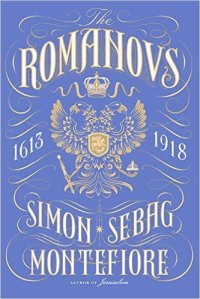
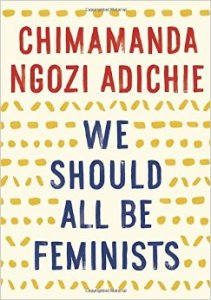
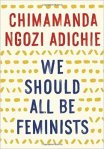
My longest book was The Romanovs: 1613-1918, by Simon Sebag Montefiore, which clocked in at a doorstopping 745 pages. My shortest book was almost 700 fewer pages, but packed just as large of a punch – We Should All Be Feminists, by Chimamanda Ngozi Adichie, was a slim 49 pages and every single word in those 49 pages was thoughtful, well-reasoned and persuasive.
Pass the Pie, Please
At the end of the year, I love to sit down and look back on who, what, where and how I read. Combing through my end-of-year statistics and creating the charts is time-consuming, but it’s always worth doing (for me, at least) – both as a record for myself and as a way to inform my reading goals, if I’m making any, for the upcoming year.
Fiction/Non-Fiction
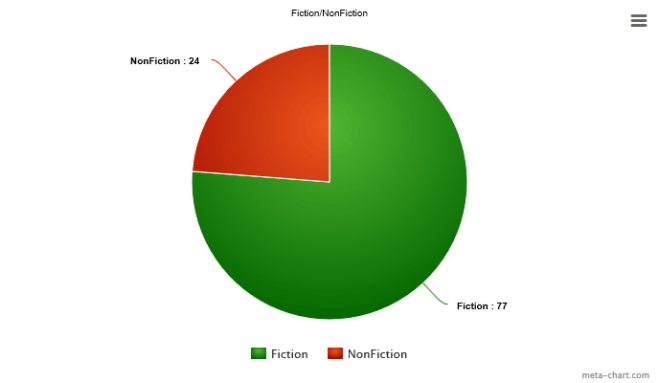
Starting with one of the easiest! I’ve always been a big fiction reader, and 2016 was no exception. Of the 101 books I read last year, 77 were fiction. Even for me, that’s a lot. There’s not much to say about this one. I’m comfortable with my general practice of reading whatever I please (or whatever is popping up in my library holds queue) and if that means I’m reading mostly fiction, I’m A-Okay with it.
Format of Book
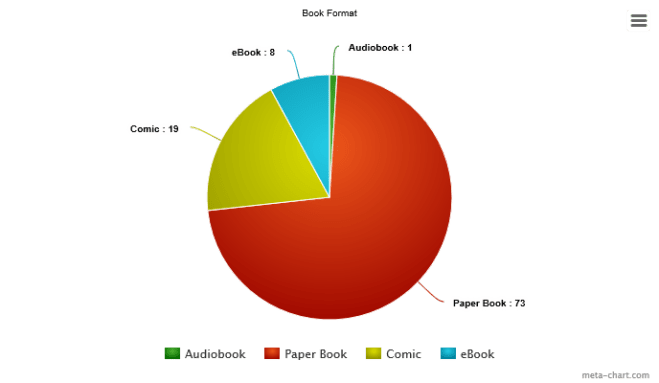
2016 was notable because I expanded my book formats a fair amount. I’m usually at or close to 100% paper books, and in 2016 I was much more varied. A few thoughts:
- I still read mostly paper books – 73 out of 100 were either paperbacks or hardbacks.
- In 2015, I started reading comics. Last year, when I reviewed my reading stats for 2015, I considered “comics” a genre – even though I knew it was really a format. This year, I’ve corrected that error. And I note that of the 101 books I read, 19 were in the form of comics. I am a trade paperback reader, so these are all collections of between four and six issues.
- I also started reading ebooks again. Last spring, I realized that I could download classics for free, via iBooks, and read them on my phone, and I read several books that way. Shortly thereafter, I discovered that reading books on my phone gives me migraines – oops. Fortunately, around the same time, I got a (free!) kindle paperwhite – so the book downloading continued and I got some use out of my kindle. Only eight books out of 101, but a good start!
- Finally, in 2016 I joined Audible and rekindled my love affair with listening to books. Back in 2013, when I was commuting by car but Steve and I had stopped carpooling, I listened to audiobooks – on CDs, checked out of the Fairfax County library system – on my commute. I got out of the habit when we moved to Buffalo, but picked it back up again last year. So, why only one audiobook on there, when I’ve been an Audible member for months? Well, my first download was a full-cast dramatization of all six Jane Austen novels, which I didn’t count as a “book” in my totals. Then I listened to – and did complete – Agatha Christie’s The Murder at the Vicarage, so that’s the one audiobook you see. My next choice was Middlemarch (after I returned a couple of audiobooks after listening to about half the content because I didn’t care for them and didn’t want to own them) and it’s taking awhile. It’s 35 hours long and it turns out that Nugget doesn’t like George Eliot. I know, he’s crazy. Finally, podcasts took up an inordinate amount of my earbud time last year, which also held my audiobook stats down. I’ve recently gone through a ruthless purge of my podcatcher, so I’m hoping that will mean more time on Audible in 2017.
Source of Book

Anyone surprised to see the giant slice of this pie chart devoted to the library? I’m a heavy public library user, and 74 out of 101 books is actually pretty low for me. There are a couple of reasons for that. First, and foremost, I moved library systems mid-year, so there was a chunk of a few weeks when I was between libraries and had no choice but to read my own books. (I was also on vacation at the time, and most of my paper books were packed away, so I relied heavily on my kindle during that time.) Second, I did venture into new territory, reading several ebooks on my phone (three, to be precise) and on my kindle (five). And then there was that one lonely audiobook. I’m always talking a big game about reading more from my own shelves, but – I’ve got to be honest – I don’t see these proportions changing much in coming years. I just love my public library way too much.
Fiction Genres
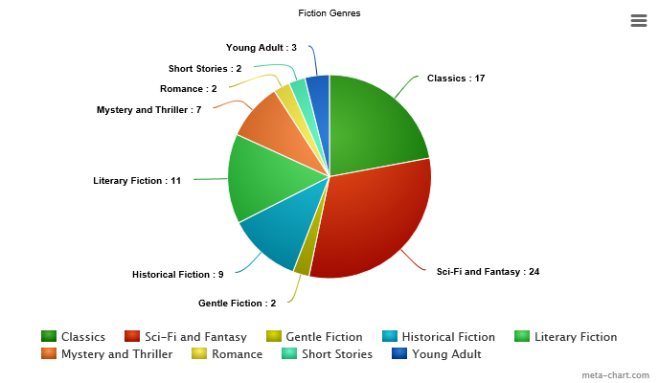
Diving a bit more into the weeds, I went through my list and broke both fiction and non-fiction down into genres. Above you can see my fiction chart. First – a word about methodology. These genre assignments are totally subjective; they’re just my gut reactions about which books belong where. If you looked at my list, you might break it down completely differently. But this list represents my best estimation of the fiction genres I read this year.
- Holy cats! Get a load of that sci-fi/fantasy category! I’ve never been a big SF/F genre reader, but I guess this year that genre really pulled me in. The reason? Comics. I classified Saga and Ms. Marvel as science fiction, and Fables as fantasy. That, right there, covers almost the entire 24 books (although there were a few others – Kindred, the N.K. Jemisins, The Invasion of the Tearling…). Upon reflecting, I thought perhaps I should have actually broken the genre out into separate categories for science fiction and fantasy – but I didn’t. Oh, well. Maybe next year, although to be honest I think this year will be an outlier in the SF/F genre.
- Classics and literary fiction are always heavy hitters for me. I was delighted to have read so many classics this year – 17 of them! Mid-century British middlebrow helped the numbers out a fair amount. Barbara Pym, E.M. Delafield, Dorothy Whipple, Angela Thirkell – more, please! And 2016 will stand out for classics as the year I first read Trollope. I’m now an unabashedly enthusiastic Trollope fangirl.
- Lots of genre this year. I’m always surprised not to see more mysteries on the list, but seven is respectable. And nine historical fiction novels! (Plus one of the books I classified as short stories – A Tyranny of Petticoats – could have fit in the hi-fi genre, too. See what I mean about it being subjective?)
Non-Fiction Genres

Pretty typical grouping here. I can always be counted on for a big chunk of history and current events, and memoir – as usual – was my other big category. New this year – essays! I can’t believe I read four books of essays. Hope to keep that up in 2017. And I’d love to read more nature writing, as well.
Settings
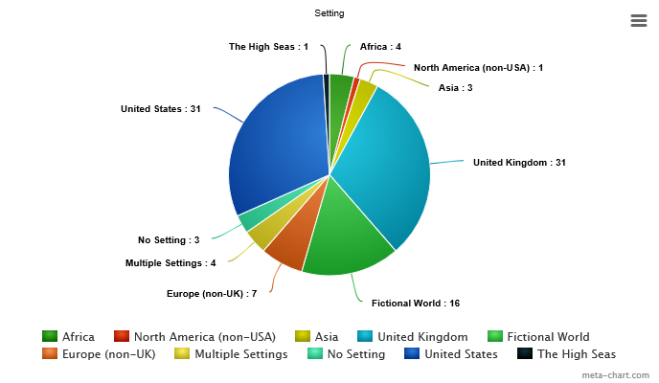
I’m always interested to see where I’m reading. Again, a quick word on methodology – this isn’t an exact science. I classified Fables, for instance, as being set in a “fictional world,” even though most of the action takes place in Fabletown, a magic secret apartment building in Manhattan – because the plot revolves around the Fables’ exile from their (fictional) fairy-tale world, the Homelands. Wherever possible, I did try to assign a setting, and I picked the setting that seemed most important to the plot or the characters’ identity, even where it wasn’t where the bulk of the action took place. You might have classified things differently, but these are the settings that seemed right to me, and well, it’s my chart.
- This chart covers both fiction and non-fiction, which is why there’s a category for “no setting.” The books in that category were mostly parenting and organizational manuals.
- As usual, the vast majority of my reading “took place” in the United Kingdom and the United States – 62 out of 101 books in those two categories alone. Even in a year when I was making a conscious effort to read diversely, I seem to gravitate toward familiar geographical settings. Something to be aware of (I was already aware).
- Curious about the one book that took place on “the High Seas”? It was Every Man for Himself, Beryl Bainbridge’s modern classic that takes place on the Titanic. Shiver.
Diverse Voices
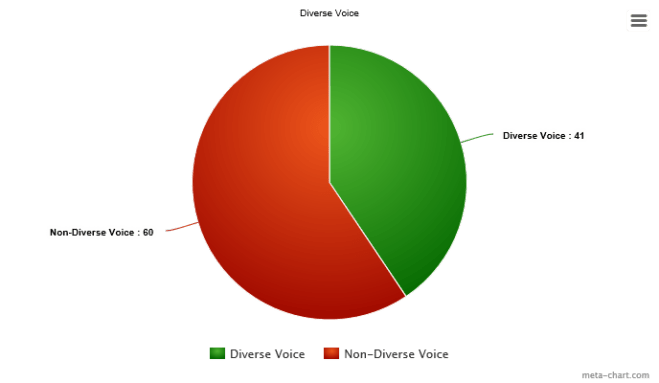
I’m prouder of this pie chart than any other. Back in January, I set a goal to read at least 33% of my books from diverse voices – whether that meant racial diversity or other underrepresented groups (Muslims, LGBT folks). At the end of the year, I found that 41 out of my 101 books were from underrepresented voices – that’s 40.5%! I am pleased, delighted, proud, and galvanized to keep that trend going into 2017. Some thoughts:
- Comics really helped my total. I counted not only writers, but illustrators, as in my opinion they drive the creative process of generating a comic just as much as the writers do. As a result, I was able to count all six volumes of Saga toward my diverse voices totals. And G. Willow Wilson (Muslim), writer of the five volumes of Ms. Marvel that I read, helped the total too.
- Without comics, I’m not sure I would have met my goal of 33% representation – as hard as I was trying. I tend to gravitate toward classics, and there are not many classic works by writers of color – because of historic and institutionalized racism. I know that there are well-documented and serious problems with representation in comics (especially by women) and I do not want to minimize that at all. But the fact is, it’s easier to read diverse voices when reading comics, because you can pick up a series like Ms. Marvel and knock off five volumes in five days. (I know, because I did that.)
- Getting to 40.5% representation took hard, sincere and determined work on my part. I’m not saying that to congratulate myself; rather, I’m trying to point out a major flaw in publishing and advertising institutions. I was constantly on the lookout for books by writers of color, making notes during podcasts and scanning internet lists for more titles to seek out. Had I not made it a priority to find these books and chase them down, they would not have found me. This is a problem with the system.
- In addition to the 41 books represented in the chart, two of the “non-diverse” books were actually well-written and thoughtful examinations of topics affecting people of color. Both The Bad-Ass Librarians of Timbuktu (about a group of heroic African librarians who saved thousands of priceless manuscripts from al Qaeda) and The Immortal Life of Henrietta Lacks (about an African-American cancer patient whose cells were harvested from her without her knowledge and used to create billions of dollars in scientific advances) were written by white writers. Both were good, important, worthwhile books, but I didn’t count them as “diverse,” because although they touched on that experience they were not written from within the communities on which they focused.
Diversity in My Booklist
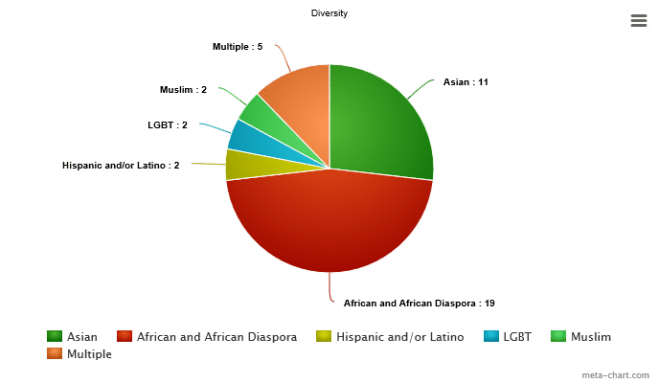
Last pie chart! Diving just a bit more into the weeds, a quick look at the different voices who made up that 41 number I’m so proud of.
- No big surprise – almost half of my 41 diverse titles were by African and African Diaspora authors. (A quick note on terminology: I did some research on the proper terms to use here and there is no universal agreement. I settled on African Diaspora because that is the term used by the African Union to identify people of African descent who live outside of the continent, wherever they happen to live. The African Diaspora in my booklist is mostly African-American, although there was one author resident in Europe – the U.K., specifically. If I give offense by use of the term, please accept my apology and know that it is unintentional – the result of my best efforts to find the right terminology – and if you know of a more appropriate phrase or term, I always want to learn.)
- I wish there had been more LGBTQ+ representation. (There’s more than it looks like, because one author got placed in the “multiple” category for being both LGBT and Asian.) There would have been, had I found the time for a Lumberjanes re-read. In 2017!
Top Ten: Favorite Books Of The Year
Still with me? I have one last item for you. I usually break this out into a separate post, but, well, the New Year’s content is already stretching into the third week in January. Quite frankly, I don’t want to spend the entire month on 2016 recaps and 2017 plans, so I’m combining what usually makes up two posts into one big monster (as noted above). So, without further preamble, and in no particular order, my ten favorite books of 2016:
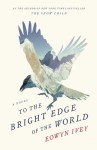
- To the Bright Edge of the World, by Eowyn Ivey.
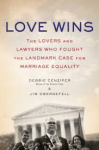
- Love Wins, by Debbie Cenziper and Jim Obergefell.
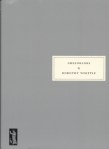
- Greenbanks, by Dorothy Whipple.
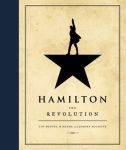

- Hamilton: The Revolution, by Lin-Manuel Miranda and Jeremy McCarter.
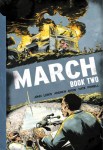
- March: Book Two, by Representative John Lewis.
- The Warden, by Anthony Trollope.
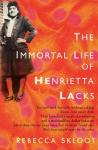
- The Immortal Life of Henrietta Lacks, by Rebecca Skloot.
- We Should All Be Feminists, by Chimamanda Ngozi Adichie.
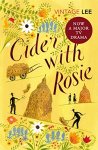
- Cider with Rosie, by Laurie Lee.
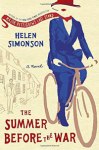
- The Summer Before the War, by Helen Simonson.
Tough choices, as always! It was a great year in reading. If you’ve made it this far, fist bumps to you. And now – onward and upward!
What was the best thing you read in 2016?
 covered in flour
Pingback: My Black History Month Reading List (And Some Other Recommendations) | Covered In Flour
Pingback: 2017: A Year in Review | Covered In Flour
Pingback: 2017: A Year in Reading – Part I (By the Numbers) | Covered In Flour