

Reading is my oldest and favorite hobby. I literally can’t remember a time in my life when I didn’t love to curl up with a good book. Here are my reads for February, 2016…
 The Immortal Life of Henrietta Lacks, by Rebecca Skloot – I had been meaning to read this one for years, and once I finally got to it, I was blown away. Henrietta Lacks was a cancer patient in Baltimore in the 1950s. Shortly before she died – from a particularly vicious strain of cervical cancer – and unbeknownst to Henrietta, doctors harvested a few of her cancerous cells. Up until Henrietta, no cells had ever managed to survive more than a few days after being harvested. Henrietta’s were special – they lived forever, dividing and dividing and dividing. HeLa, as the cells were named, went on to be instrumental in some of the most important scientific discoveries of the twentieth century. They were used in testing some of our most prevalent drugs. They were blown up in atomic bombs and shot into space. And all the while, Henrietta’s family had no idea that her cells lived on. They only discovered HeLa’s existence in the 1970s – more than twenty years after Henrietta’s death. To this day, they have not been paid for the cells, which were extracted without Henrietta’s knowledge or consent. And many of Henrietta’s descendants cannot afford health insurance. Henrietta Lacks is all the more amazing – and disturbing – of a story for being true. In Skloot’s capable hands, the reader comes to care deeply about Henrietta, her family, and the unfair system that has allowed some to profit handsomely from her cells while her family goes without insurance. My only complaint was Skloot’s occasional penchant for describing people by their weight – I don’t need to know that a particular individual was “a substantial woman, about 200 pounds,” or that another individual was 400 pounds. It wasn’t germane to the book and seemed a bit disrespectful. But that is my only (minor) quibble with the book – overall, I thought it was spellbinding and fascinating. Henrietta Lacks should be required reading for all human beings.
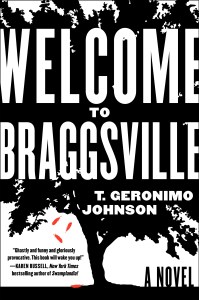 Welcome to Braggsville, by T. Geronimo Johnson – Daron Davenport is a son of the South, away from home for the first time as a student at UC Berkeley. When he mentions in a class that his hometown, Braggsville, stages an annual Civil War reenactment, Daron’s friends seize on the idea of a performance protest. They traipse to Braggsville for spring break and proceed to stick out like sore thumbs everywhere they go – but their antics take a quick turn from comedic to tragic. So… I liked Braggsville, but didn’t love it. The plot was intriguing, but something about the writing style just didn’t resonate with me. You ever read one of those books where you can appreciate that the writing is excellent, but it’s just not grabbing you? That was my experience with Braggsville. I found it hard to get invested in the story as a result. Still a worthwhile read and particularly interesting during Black History Month.
 March: Book One, by John Lewis – March is going to be a trilogy of graphic memoirs recounting the life of Congressman John Lewis and his role in the Civil Rights Movement. This first volume described Congressman Lewis’ rural Southern boyhood, his college years in Nashville, and the beginnings of his involvement with nonviolent protest. I found it riveting and powerful – the graphic novel format was a really unique way to tell the story, and Lewis’ voice comes through beautifully. I immediately checked the second volume out from the library.
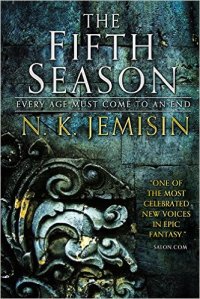 The Fifth Season (The Broken Earth #1), by N.K. Jemisin – I don’t know how to describe this book without going on for paragraphs and paragraphs, giving away the story, or both… but I’ll try. The Stillness is a vast continent that is plagued by seismic events – earthquakes, tsunamis, disasters of all stripes. Resident on the Stillness, amongst the ordinary “stills,” is a race of people called “orogenes,” who can sense and control the geologic environment. The orogenes are feared and hated for their powers, but the stills also need their skill, and so the entire group has been suborned to the point of slavery – until a few orogenes decide that they’ve had enough. I don’t want to say any more, because I don’t want to risk spoiling the many surprises. The Fifth Season was my first N.K. Jemisin experience, and I was incredibly impressed with her world-building and her beautiful writing. I’ll be reading her entire backlist now, kthanksbye.
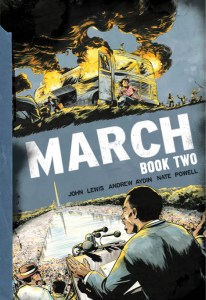 March: Book Two, by John Lewis – I couldn’t leave March this month, so I returned to Congressman Lewis’ memoirs for the second volume. The Congressman finds himself in more and more volatile of a situation as he assumes a leadership role, first in the Freedom Rides, and then in SNCC, the nonviolent student organization he helped to found. The volume concludes with the March on Washington and Dr. Martin Luther King’s “I Have a Dream” speech, and it is incredibly moving and powerful. What a wonderful way to tell such an important story – everyone should read March. I’m now impatiently waiting for the third and final volume.
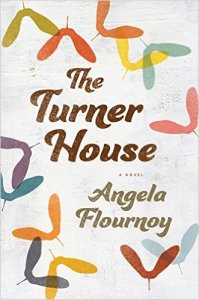 The Turner House, by Angela Flournoy – The Turner house stands on Yarrow Street in a crumbling Detroit neighborhood. For years, the house has sheltered Francis and Viola Turner and their thirteen children, from Cha-Cha, the responsible eldest son, to Lelah, the baby of the family. Now Francis has passed away and Viola is dying. The house – all but abandoned – is only worth about $4,000, but Viola still owes $40,000 on it. Against this bitter backdrop, the Turner children gather to debate what should be done with their family home. As the discussion unfolds, the children deal with their own private dramas. Cha-Cha believes that he is being haunted, and the “haint” is causing both Cha-Cha and his marriage to unravel. Twelfth child, Troy, is determined to buck his elder brother and take the house’s fate into his own hands. And Lelah, the youngest, is coming undone – evicted, recently backslid into a gambling addiction she had worked hard to break, and at odds with her only daughter. I loved this book. Each of the Turners felt so real – the characterization was absolutely masterful. Cha-Cha, in particular, was such a wonderful character, and I rooted for him to confront both his haint and the pressures of being the new family patriarch. I simply can’t believe that The Turner House is a debut novel – if this is Angela Flournoy’s first effort, I can’t wait to see what she does next.
February, as most of my friends are no doubt aware, is Black History Month in the U.S. Early in the month, I decided that I really wanted to celebrate by reading as many books by African-American authors as possible, and I certainly met that goal. Of the six books I read this month, five were by African-American authors, and the sixth – Henrietta Lacks – was a sensitive and well-handled discussion of race and ethics in medical research, an issue that should be important to all of us, but that has particular implications for people of color, who have been disproportionately ill-treated by ethical and legal “rules” that do not require patient consent for taking and using human tissue. (As a lawyer, I was stunned by this.) I felt great about my Black History Month reading – some good fiction, some good non-fiction, and the discovery of two voices in fiction – N.K. Jemisin and Angela Flournoy – that I will enjoy following for years to come. A successful month, indeed!
What were your reading highlights in February?
 covered in flour