
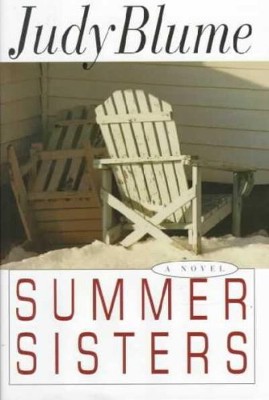
It’s that time again – time to talk Judy Blume with my fellow #BlumeAlong participants! If you missed previous discussions, #BlumeAlong is a Judy Blume readalong hosted by Kerry at Entomology of a Bookworm. We’ve already discussed Are You There, God? It’s Me, Margaret, and now we’ve moved on to something a good bit steamier: Summer Sisters.
Synopsis
Victoria “Vix” Leonard is twelve years old when Caitlin Somers chooses her as a friend. Vix can’t believe her luck when pretty, popular Caitlin invites her to spend the summer on Martha’s Vineyard. Soon Vix is part of the family – Caitlin’s “summer sister” and surrogate daughter to Caitlin’s father Lamb and his new wife, Abby. Those first summers are idyllic, sun-drenched months of sand, surf and… ahem… discovery. But as Vix and Caitlin grow into teenagers, and then young women, their friendship will become infinitely more complicated. Competition for boys and… ahem… milestones heats up with the summer sun, and Vix must learn to protect her heart, even from her summer sister.
My Thoughts
I read Summer Sisters years ago, when I was in high school. (It must have just come out when I first picked it up, because the credits say it was published in 1998, and I graduated in 1999.) I remember being fascinated by Caitlin’s privileged world, and blushing extremely hard at some of the girls’ antics, especially once island boys Von and Bru came on the scene. (I was quite sheltered.) When I first read Summer Sisters, it was a voyeuristic glimpse into a different world, and I liked that.
Reading it as an adult – and it is, most definitely, a novel for adults – what strikes me most is the complexity of the central friendship. This is Judy Blume, and there is a huge cast of characters and many relationships to navigate, but Vix and Caitlin’s incredibly complicated friendship is the focal point. It was bittersweet, certainly, and fascinating, and relatable to at least a certain extent. After all, what woman has not had a complicated friendship or two of her own? Girlfriends can be much more intense than boyfriends, and those teenaged years are the time to figure out the give and take that make up adult friendships.
It was there that I thought Vix was maddening. I’ve had more than one complex friendship – we all have. I’ve never had anyone quite like Caitlin in my life, but I have had friendships that have taken very intense turns. I think it’s a right of passage for growing up female. But a rite of passage means just that – passage. Those friendships serve a purpose; they help us grow. But ultimately, we must learn to assert ourselves and figure out how to be part of an adult friendship, and that was something that I don’t think Vix learned to do. Those intense teenaged friendships don’t last. They either evolve, or they fizzle.
I think it’s telling that neither of the women I currently consider my “best friends” were the other party in any of my very intense friendships. One of my closest friends is someone I have known since middle school, and we have been friends since we met, but we really became close in college – once we were both mature enough to understand and partake in a more adult friendship. The other woman is someone I met and became friends with in college – one of my sorority sisters. It is those friendships, which escaped that truly intense period, that I think are going to last. And my most Caitlin-esque friends? I’ve lost touch with them, and I’m okay with that. I can now see that they were not healthy relationships. I can value them for what they were, but I’m glad they’re in the past.
Vix never quite learned to get over Caitlin, and their friendship never evolved. Caitlin was always the dominant personality; Vix was just grateful that Caitlin chose her as a friend. I kept waiting for Vix to tell Caitlin off (although, having read the book before, I knew she wouldn’t). I had to agree with Vix’s college friends Maia and Paisley – I wasn’t sure, by that point, what Vix saw in Caitlin. It seemed to me to be a one-sided friendship, and I wished that Vix, so mature in other respects, would grow up and demand a more equal, adult friendship.
I enjoyed Summer Sisters, although not as much as I did when I first read it. I was less shocked by the “adult content” – since, you know, I am an adult now – and was more able to focus on the relationships. I loved Abby, a figure who barely registered the first time I read the book – on this read, I found myself identifying with Abby more than anyone else. And Vix’s brother Nathan broke my heart.
All told, Summer Sisters was – of course – well-written, engaging, and more than a little scintillating. It was fascinating to read it as an adult, since I was about 16 when I last read it. It might not be my favorite Judy Blume, but as summer reading goes, it doesn’t get much hotter than Summer Sisters.
Have you read Summer Sisters? What do you think?
 covered in flour
Pingback: Reading Round-Up: July 2015 | Covered In Flour
Pingback: The Summer List: Final (Super Belated) Update | Covered In Flour