
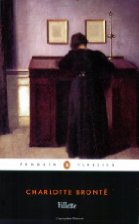
Well, this Sunday ended the first part of the Villette readalong, hosted by Beth over at Too Fond. We were to read Volume I of the novel, which introduces the characters and spends a little time placing them into their setting. (My edition of the book – part of a volume collecting the complete novels of Charlotte and Emily Bronte – inexplicably doesn’t break the story down into volumes, so I looked up the table of contents on the Internets, and the Internets told me that Volume I corresponded to chapters 1 through 15. I hope I didn’t get fed a line.) I had a tough time making time to read this week, between three nights of working late during the week and hosting the grandparents, two aunts, and two godparents for Peanut’s Baptism over the weekend. So I didn’t quite get through the end; I’m up to about midway through chapter 14. But I promised you a Villette post today and I don’t want to be late for the link-up, so I’ll give you the story and my thoughts as far as I’ve gotten.
The Story
In the first part of Villette, we meet most of the important characters, including the main protagonist, Lucy Snowe. Lucy is something of a mysterious character. She seems to be in reduced circumstances, although just how reduced isn’t clear. (She seems to be better off than Jane Eyre – she’s not quite as destitute as Jane, and her childhood is rather friendlier.) The story opens with the young (age 12 or 13, most likely) Lucy staying at her godmother’s pleasant home in quiet Bretton. Lucy’s godmother, Mrs Bretton, has a son slightly older than Lucy, and she soon takes on another houseguest: the precocious child Polly Home. Polly’s mother has recently died and her father, to whom she is devoted, is traveling. Polly at first is bereft, but soon comes to idolize Graham Bretton, the son of the house. Graham, for his part, enjoys the attention little Polly lavishes on him, but doesn’t seem to realize the depth of the sensitive child’s feelings.
The party at Bretton breaks up, we jump about eight years forward in time and Lucy has moved on, eventually spending one chapter tending to a sick old woman, Miss Marchmont, and it is here that we learn that Lucy is more or less penniless and friendless – although she still doesn’t seem to have been as cruelly handled as Jane Eyre was. Lucy and Miss Marchmont develop a tentative bond, and Miss Marchmont shares her tragic love story. When Miss Marchmont dies, Lucy takes her remaining salary and strikes off for parts unknown – first London, where she shows herself around, and then to the continent, to try to land herself work as an English governess (or anything else). On the ship to the continent, Lucy meets a spoiled young woman named Ginevra Fanshawe, who babbles on about her uncle and godfather, M. de Bassompiere, and her destination: Madame Beck’s, a school for young ladies in the posh city of Villette. After dawdling in the port city, Lucy decides to head for Villette herself.
Lucy arrives at Villette in the dark and the rain, only to find that her luggage has been left behind. A young Englishman gives her directions to an inn, but through an accident of luck, she finds herself at Madame Beck’s door instead. In the dark and the rain of the late night, Lucy knocks on the door and talks herself into a job as governess to Madame Beck’s three children. Madame Beck is a formidable character, who hires and fires at will, snoops in her employees’ possessions, and rules the school with her whims. It is through one of these whims that Lucy finds her comfortable governess job snatched from her, and a terrifying post as the school’s English teacher thrust upon her. After a rocky start, she finds herself at least respected by her students. She also re-makes the acquaintance of the helpful Englishman who directed her (unintentionally) toward Madame Beck’s: he turns out to be a doctor who attends to Madame Beck’s children in the absence of their regular physician. Lucy is shy around “Dr. John,” and he doesn’t seem to notice her at all – but she thinks he might have feelings for someone at the school.
The school is an odd garden for Lucy to bloom. She doesn’t share the other students’ or teachers’ Catholic faith and she’s naturally more reserved and serious than most of her pupils – including the spoiled Ginevra Fanshaw – and colleagues. This point is brought home when a little box is flung from the window of a neighboring building into Madame Beck’s garden and Lucy picks it up. It contains a love note, clearly meant for someone at the school, and referring to the “dragon” of an English teacher Dr. John arrives moments later and takes the box from Lucy, promising to hand it over to Madame Beck. Does Dr. John know who the letter-writer is, or who the intended recipient is? Is he himself the letter-writer? Lucy ponders these mysteries while Madame Beck snoops around and listens in on her conversations. Meanwhile, the school prepares for its annual fete of Madame Beck and Lucy finds herself swept up into a more central role in the preparations than she had hoped for.
Thoughts Thus Far
After Volume I (or, at least, most of it) there’s still a great deal that we don’t know about Lucy. How did she come to be so alone in the world? Her childhood, while not exactly grim – I keep comparing her to Jane Eyre, who did seem to have it worse – was not exactly idyllic, and in her adulthood, she finds herself in the position of having to earn her own living by constantly proving her worth to strangers. I expect Bronte is withholding the details of Lucy’s early life – while giving us just enough so that we know who we’re dealing with – because she wants the reader to take Lucy as she is, at least for now.
On Twitter, I mused that Lucy is quite brave when she has nothing to lose – departing for London, and then Villette, on a whim when she knows no one in either city – but timid when she is asked to give up a comfortable position. Left to her own devices, it’s possible that Lucy would have happily spent years tending to Madame Beck’s children. Instead, she finds herself an English teacher, interceptor of love notes, and play-actress. Lucy rises to these challenges reluctantly, but rise to them she does.
Madame Beck is another interesting character. My twenty-first century American sensibilities were offended by her spying and her snooping through Lucy’s personal effects. Indeed, Lucy shrugged off Madame’s multiple violations of her privacy far more easily than I did. Perhaps it’s a personality quirk of Lucy’s – that she’s able to forgive and forget (well, forgive) Madame’s spying – or perhaps it’s the times, and employees expected their employers to take liberties with their possessions, or perhaps it’s just that Lucy can’t afford to irritate Madame because if she does, she’ll be “out on her ear” with no money, no reference and nowhere to go. At the moment, Lucy and Madame are working together a bit uneasily. I could see the relationship developing into that of great allies or great rivals.
Then there’s Dr. John. The household staff is convinced that Madame is in love with him and Lucy believes that, if he has feelings for anyone at the school, Madame would be the recipient of his affections. But Madame is older, likely older than Dr. John, and rather formidable. I’m not so sure that Dr. John comes to the school so frequently out of some feeling for Madame. Lucy also speculates about the household staff. Rosine, the portresse, seems a likely possible recipient of the love note Lucy intercepted. And Dr. John was on the scene promptly when Lucy picked up the note. He had a simple explanation – he was attending a patient in another house, saw a handkerchief wave from the school and a box drop from a window – but Lucy doesn’t seem to be completely convinced by his story. There’s another one to watch.
Overall Impressions
Villette is a more complicated novel than Jane Eyre. There are more characters to keep straight and more mystery; in Jane’s sphere, things are relatively black and white, but Lucy’s world is populated by ambivalent characters with unclear motives. Lucy herself is an enigma. Clearly, she’s got a past, but she’s not telling. Reading Villette is something of an exercise in filing away clues and anecdotes because I’m convinced they’ll become important later. It’s almost like solving a fun mystery.
It’s been a tough week for reading. I have another huge library stack to contend with – more on that later – a big, stressful project at work, and family in town. There were times over the weekend when Peanut was napping and I wanted nothing more than to curl up with Lucy and friends – but I couldn’t, because I was “hostessing.” I’m looking forward to life getting back to my nice normal, quiet pace this week, and I expect to make up ground on Villette as soon as it does.
 covered in flour
Love reading your thoughts on volume I! I agree that there is still a lot of mystery surrounding Lucy, especially in regards to her childhood. I can’t help but think there was some great trauma there, but I’m not sure how many details we will get. I finished volume I last night and volume II starts off with a bang–I’m already loving it and feel much more settled in the book. Hope this week a bit easier on you and you get more chance to read.
Now I have to go off and write *my* volume I wrap-up, which is very late! I’ll link up to yours and others in the same post.
I agree – where are her parents, did she have any siblings, and what happened to the Brettons that they weren’t an option for her? I just finished Volume I last night – finally – and I am going to take a break tonight to work on my library book (I’m trying to avoid an overdue fine, and I’m too deep into it not to finish now, plus it’s good!) but then I’m looking forward to picking back up with Lucy.
Very interesting! I finished Vol. I, but I’m not going to have time to do a thorough wrap-up (this month is crazy at work, and my husband ended up in the hospital over the weekend–thankfully, he’s fine now and back at home). Anyway, I enjoyed Vol. I, particularly when she refuses to dress like a man (the so-called “nobler sex”). She’s a great character, and I’m looking forward to getting to know her better. I’m in the middle of a couple of books right now, and I’ve found that Villette is the one I think about the most.
Ah, those crazy work months – I’ve had one too, so I can readily sympathize. I think my favorite part of Volume I was the scene in “The Fete,” when she goes to town on Dr. John for being insensitive. Sarcasm FTW!
Pingback: Cats Are the Solution to Writer’s Block (Well, Sort Of) | The Misfortune Of Knowing
Pingback: #Villettealong: Reading Companions | Covered In Flour
Pingback: Reading Round-Up: June 2013 | Covered In Flour
Pingback: Happy 2014! (And a Look Back at 2013) | Covered In Flour