
I had never heard of Jostein Gaarder until college. And even then, it was only by chance that I stumbled across him. I’d gone the “practical” route as college majors were concerned, choosing a major in the social sciences that I thought would set me up for law school. And while I loved my labor economics and collective bargaining classes, I was secretly a little jealous of my friends who were studying literature and philosophy while I read labor history. (In retrospect, I could have branched out and taken more “just for fun” classes, but I was quite single-minded back then. If I had it to do over again, I would have encouraged my younger self to take literature and French.)
So I heard about Jostein Gaarder from a dorm friend who was assigned Sophie’s World for a philosophy class. One night, as we were hanging in her room, she handed me her copy and told me it was a novel about a girl who is mysteriously enrolled in a philosophy correspondence class. I was intrigued and my friend loaned me her copy of the book, which I read quickly. I loved Gaarder’s style of writing a “story within a story” – you know that the narrative is shifting when the typeface changes, which was something I just found incredibly charming and engaging. And then it was all over for me – I started looking for more Jostein Gaarder books in every bookstore. Here are some of my favorites…
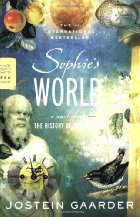 Sophie’s World: Already mentioned, of course. Sophie is a young girl who finds a letter in her mailbox one day, enrolling her in a correspondence class on the history of philosophy. The book alternates between telling Sophie’s story and detailing the history of philosophy through the letters that Sophie receives. The end of the book is truly mind-boggling (but I’m not going to spoil it for you; you’ll just have to read). Sophie’s World is probably the most difficult to read of all Gaarder’s works – just because it’s dense – but it’s a gateway drug.
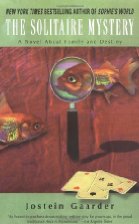 The Solitaire Mystery: This was the second Gaarder book I got my hands on, and to this day it’s my favorite. Young Hans and his father set off on a road trip through Europe to search for Hans’ mother. On the way, Hans receives a deck of cards and a magnifying glass. When Hans examines the cards, he finds that each card is a chapter in a fantastical tale about a group of playing cards who come to life and inhabit a magical island. It’s a colorful, mystical book.
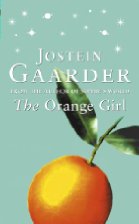 The Orange Girl: “If I’d chosen never to the foot inside the great fairytale, I’d never have known what I’ve lost. Do you see what I’m getting at? Sometimes it’s worse for us human beings to lose something dear to us than never to have had it at all.” This one is heart-wrenching. Georg receives a letter from his dead father, in which his father details his search for a young girl who sells oranges in Seville and Oslo. Again, as is typical of Gaarder’s work, the typeface changes as the story alternates between Georg’s life and the letter.
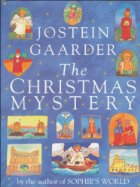 The Christmas Mystery: It’s become a tradition of hubby’s and mine to read The Christmas Mystery out loud, one chapter each day starting on December 1st, until Christmas Eve. The book is structured like an Advent calendar, and it is in fact the story of a boy who acquires a magic Advent calendar. Each morning, Joachim opens his calendar to find a new chapter in the fantastical story of a young girl, Elisabet Hansen, who disappeared from his town fifty years before. Elisabet’s magical Christmas journey will touch the lives of Joachim, his family, and several other residents of their town. I love-love-love The Christmas Mystery, and my holiday season isn’t complete without it.
Have you read any Jostein Gaarder? What’s your favorite of his books?
 covered in flour
I love The Christmas Mystery – I stumbled on it in Oxford years ago. I haven’t read any of Gaarder’s other work, though – clearly I have some catching up to do!
You’d definitely like his other work! Check out “The Solitaire Mystery” – it’s wonderful.