
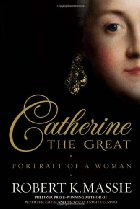
 Robert K. Massie is arguably the best modern biographer of the Russian tsars. His works are richly detailed and meticulously researched, but readable. I loved his account of the last Russian Imperial family, Nicholas and Alexandra, and so I was very excited to read his newest biography, Catherine the Great.
Catherine the Great begins with an account of Catherine’s childhood as Princess Sophia of Anhalt-Zerbst. Sophia was born to a minor German prince and his rigid, unhappy, ambitious wife. Sophia’s mother, Princess Johanna, resented Sophia for being a girl… at least, until the Empress Elizabeth of Russia chose Sophia as the bride to her nephew and heir, the Grand Duke Peter. Johanna and Sophia immediately journeyed to Russia together, where Sophia set about winning the affection and confidence of Empress Elizabeth (overcoming the roadblocks that Johanna set up by viewing herself as a secret agent of Prussia’s Frederick II and constantly bungling her “spying” endeavors). Sophia converted to Russian Orthodoxy, became Catherine, and was betrothed and then married to Peter. Unfortunately, it took her nine years to accomplish the one task Elizabeth had in mind for her – producing an heir to the Russian throne – because her husband slept next to her for nearly a decade while rebuffing every attempt she made to, um, carry out Elizabeth’s orders. Catherine finally was persuaded to take a lover and it’s unclear whether her heir, Paul, was the result of her marriage or her extracurricular activities.
Eventually, Elizabeth died and passed Russia to Peter, who was an immensely unpopular emperor. Peter hated Russia and idealized Prussia; he called Frederick II “the king my master” and instituted an ill-fated alliance with Russia’s historic antagonist, as well as number of unpopular and idiotic policies. The pressure mounted and eventually, supported by the Russian military and church, Catherine mounted a sudden coup and took over the throne from her hapless husband. She proceeded to rule for over 30 years. Catherine’s reign was not always smooth – there were wars and attempted peasant revolts – but there were few monarchs in Russian history who proved as dedicated or inspired as she. Catherine first attempted to create a new code of laws based on Enlightenment principles. She went on to become a philosopher-empress who read widely, always entertained opposing viewpoints, assembled Europe’s foremost art collection of the day and built schools, hospitals, towns and cities, and persuaded thousands of Russians to be inoculated against smallpox. She added vast swaths of territory to the Russian empire through wars and annexations (the wars were fair; the annexations were not). Her personal life was often criticized: she took a parade of ever-younger lovers. But her legacy remains as one of the greatest rulers Russia has ever had and, likely, ever will have.
Catherine would be a challenging figure for a biographer. Her life was dramatic and full, her accomplishments vast. But in the hands of Robert K. Massie, she comes to life. This is a LONG, dense book, but worth reading for anyone who has an interest in Russian history.
Get the book! Catherine the Great: Portrait of a Woman, by Robert K. Massie (not an affiliate link)
 covered in flour
Pingback: Reading Round-Up: May 2012 « Covered In Flour